
Table of Contents
Efficiency degradation drives operating costs steadily upward — 24% decline over 7 years
Traditional centrifugal pumps degrade faster in fountain applications than in most industrial uses. A 7-year tracking study published in 2019 by the Fluid Machinery Laboratory at Delft University of Technology (TU Delft) showed that the combined efficiency of pump units across 10 European fountain projects dropped from 72-78% when new to 48-57% after 7 years, with an average annual degradation rate of 3-4%. After the 5th year, the annual incremental electricity cost for all tracked projects had already exceeded the annual equipment depreciation. This means that performance degradation not only affects the visual quality of fountain displays but also represents a steadily climbing hidden operating cost.
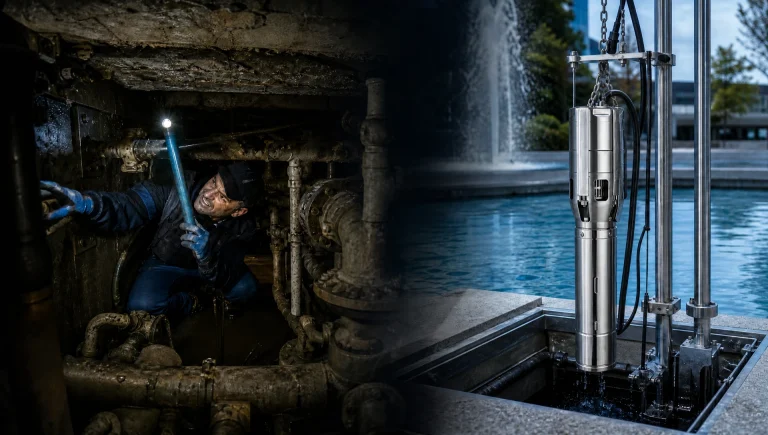
performance degradation is not an inevitable fate of traditional high-pressure pumps — the submersible pump technology, with its fully submerged architecture, removes this trigger at the design stage.
In-Depth Technical Analysis
Three Core Mechanisms of Performance Degradation
Traditional centrifugal pumps degrade faster in fountain applications than in most industrial uses because the fountain environment subjects them to multiple wear-accelerating factors simultaneously: impeller wear, wear ring clearance enlargement, and pipe scaling.
Efficiency Decline Caused by Impeller Wear
Particulate matter in the circulating water — sand grains, algae fragments, rust flakes — impacts the impeller blade surfaces at velocities of approximately 3-20 m/s. As the impeller surface material is micro-machined away, surface roughness increases from the factory Ra 1.6 μm to Ra 8-12.5 μm within 1-2 years. Once the surface roughens, flow resistance within the impeller passages increases, boundary layer thickness grows, and energy transfer efficiency drops. Measured data: increasing surface roughness from Ra 1.6 μm to 12.5 μm can reduce pump efficiency by 5-8%.
Increased Internal Leakage from Wear Ring Clearance Enlargement
The wear ring is the sealing clearance component between the impeller inlet and the pump casing on a new pump, with a standard clearance of 0.25-0.40 mm. Under fountain water abrasion, the wear ring clearance enlarges at a rate of 0.1-0.3 mm per year. After 3-5 years, the clearance may expand to 0.8-1.5 mm. The enlarged clearance allows high-pressure water from the impeller outlet to flow back through the wear ring gap to the low-pressure inlet (“internal leakage” or “volumetric loss”). Volumetric loss increases with the cube of the clearance — when the clearance grows from 0.3 mm to 1.2 mm, volumetric loss increases approximately 64-fold. This is the primary reason centrifugal pumps seem to “lose power” over time.
Pipe Scaling Shifting the System Resistance Curve
In hard water regions, pipe walls accumulate scale year after year, reducing the internal pipe diameter and increasing the friction coefficient, causing the system resistance curve to shift upward year by year. The pump’s characteristic curve remains unchanged, but the pipe resistance curve continues to rise, and the intersection of the two (the actual operating point) shifts toward lower flow. The pump must consume more energy to overcome the additional pipe resistance, yet the effective water flow delivered actually decreases.
From an engineering perspective, this is exactly where a submerged architecture changes the picture: the submersible pump technology with its “Sealed Against Abrasion” design acts directly on the failure chain described above, making the problem structurally unlikely to occur instead of requiring post-event repairs.
TU Delft 7-Year European Fountain Tracking Study Data
- New pump combined efficiency range: 72-78%; after 7 years: 48-57%; average annual degradation rate: 3-4%.
- Accelerated degradation period: years 3-5, with annual degradation rates of 4-5%. For every 1% efficiency drop, electricity costs increase by approximately 1.3-1.5%.
- After the 5th year, the annual incremental electricity cost for all tracked projects had already exceeded the annual equipment depreciation.
- China scenario: A 100 kW pump unit’s annual electricity cost of ¥233,600 in year 1 → efficiency drops approximately 24% by year 7 → annual electricity cost rises to ¥290,000. The 7-year cumulative excess electricity cost is approximately ¥300,000-400,000 — enough to purchase a brand-new high-efficiency pump unit.
On a whole-life-cycle basis the conclusion is the same: projects that choose the submersible pump technology see the “Wear-Resistant Coated Impeller” advantage converted into measurable savings on electricity, maintenance and downtime year after year.
Standards & Compliance
TU Delft study recommends: conduct efficiency testing every 3 years and treat wear rings as replaceable consumables for scheduled replacement. Perform pump unit efficiency testing every 1-2 years (using detachable ultrasonic flow meters and pressure sensors) to establish an efficiency baseline profile. When efficiency drops more than 10%, consider overhaul or impeller/wear ring replacement.
International Case Studies
🇳🇱 1. TU Delft — 7-Year Tracking Study of 10 European Fountains
Project Background: The Fluid Machinery Laboratory at Delft University of Technology conducted a systematic performance degradation tracking study on 10 European fountain projects of varying scales between 2012 and 2019. These fountains were located in the Netherlands (5 sites), Germany (3 sites), and Belgium (2 sites), covering indoor and outdoor, musical and static fountain types.
Equipment Setup: Each fountain underwent efficiency testing every six months (measuring input electrical power, pump outlet flow and pressure, and calculating hydraulic power and overall efficiency), with maintenance and replacement records documented simultaneously. Field testing used ultrasonic flow meters and precision pressure sensors.
Root Cause: Wear of mating components (wear rings) accelerating internal leakage was the primary factor, contributing approximately 55% of total degradation. Flow efficiency loss from impeller surface roughening contributed about 25%. Pipe scaling and system resistance increase contributed about 15%. Other factors (motor aging, bearing wear, etc.) contributed about 5%.
Consequences & Losses: During the study period, 7 of the 10 projects underwent at least one major overhaul (wear ring replacement, impeller replacement, or pump body repair), each costing approximately €8,000-25,000. After overhaul, efficiency recovered to 85-92% of the initial value.
Prevention: Conduct pump unit efficiency testing every 1-2 years to establish an efficiency baseline profile. Consider overhaul when efficiency drops more than 10%. Mandate wear ring replacement every 3-5 years regardless of visual condition. Design pipe systems with chemical cleaning ports and perform chemical descaling every 2-3 years. Use wear-resistant materials (ceramic-coated impellers or high-chromium cast iron impellers), which can reduce wear rates to 1/3-1/5 of standard cast iron.
Source: TU Delft Laboratory of Fluid Machinery Report 2019; Journal of Hydraulic Engineering (ASCE)
🇦🇪 2. Burj Al Arab, Dubai — Jet Height Dropped from 18 m to 10-12 m
Project Background: The fountain water feature at the entrance of the Burj Al Arab hotel in Dubai is the hotel’s signature landscape. Built in 1999, the fountain’s jet height had dropped from the initial 18 m to 10-12 m after 8 years of operation — a decline of 33-44%.
Equipment Setup: Multiple multi-stage centrifugal pump units were used, with pump bodies made of 316L stainless steel to withstand Dubai’s high-temperature, high-humidity, high-salinity environment.
Root Cause: The wear ring clearance expanded from the factory 0.3 mm to approximately 1.2 mm, with volumetric loss increasing approximately 64-fold — the primary cause of jet height reduction. The impeller surface showed significant irregular flow passages due to abrasion. Pipe walls had approximately 5 mm of scale deposits. The impeller exhibited edge defects from cavitation.
Consequences & Losses: The reduced jet height severely impacted the hotel’s landscape aesthetics and guest arrival experience. The repair — replacing all impeller assemblies, applying ceramic coating restoration to the pump body interior, chemical pipe descaling, and upgrading wear ring materials — cost approximately €90,000. After repairs, the jet height recovered to 92% of the initial value (approximately 16.5 m).
Prevention: Use replaceable wear ring designs. In hard water regions, perform pipe descaling and cleaning regularly (every 2 years). Install online efficiency monitoring systems. Use full-ceramic impellers (reaction-bonded silicon carbide, SiC) or ceramic-coated impellers — the abrasion rate is only 1/10 that of 316L stainless steel.
Source: Jumeirah Group Engineering Reports; third-party pump equipment assessment company technical report
🇨🇳 3. Northern Chinese City Plaza — 5-Year Efficiency Degradation Field Test
Project Background: A musical fountain at the central plaza of a major city in northern China (hard water region, water hardness 300-450 mg/L). The pump units were commissioned in 2015, and the first efficiency test prior to overhaul was conducted in 2020.
Equipment Setup: Six 45 kW horizontal centrifugal pumps with Y-strainers (80 mesh) at the inlets, DN200 carbon steel main pipes. Water source: municipal water supply.
Root Cause: High water hardness + fountain evaporation concentration → annual scale deposits of approximately 2 mm on pipe walls → pipe diameter reduced by approximately 20% after 5 years. Improper strainer maintenance → sand particles entering the pump body → accelerated impeller wear. Wear rings not replaced as consumables on schedule → clearance expanded from 0.35 mm to 1.1 mm.
Consequences & Losses: After 5 years: single pump flow rate under the same operating conditions dropped from the design 120 m³/h to 82 m³/h, a 32% decline. Pump outlet pressure dropped from 40 m to 31 m. Combined efficiency dropped from 74% when new to 51%. Annual electricity cost increased from ¥118,000 to ¥172,000 (a 46% increase). Overhaul cost ¥180,000. Efficiency recovered to 89% of the initial value after overhaul.
Prevention: Use replaceable wear ring designs and mandate wear ring replacement every 3-5 years. In hard water regions, perform chemical pipe descaling every 2 years. Install online efficiency monitoring systems with automatic alerts when efficiency drops more than 10%. Use ceramic-coated impellers or high-chromium cast iron impellers with abrasion rates only 1/3-1/5 of standard cast iron. Strengthen strainer maintenance to prevent sand from entering the pump body.
Source: Project operator internal maintenance evaluation report; Chinese fountain and water feature equipment maintenance exchange materials
Avoiding the Problem at Its Root: New-Generation Submersible Pumps
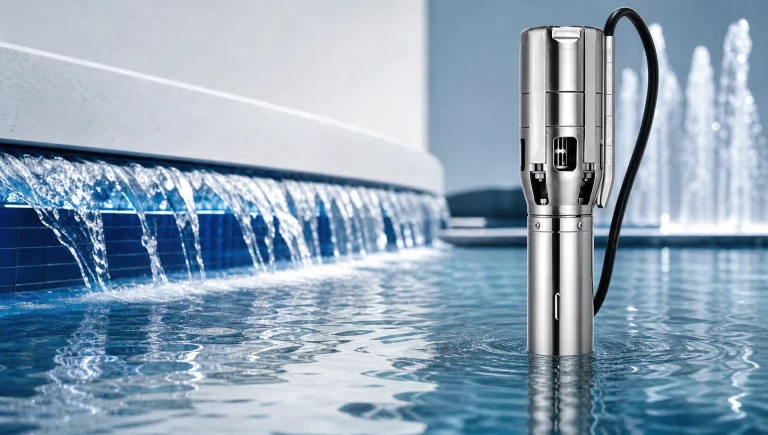
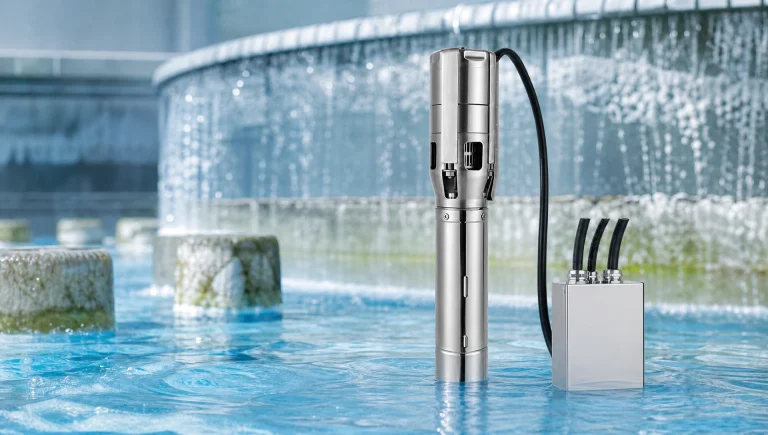
The primary causes of performance degradation — wear ring wear, impeller roughening, and pipe scaling — are the price paid for long-term exposure of water-external components. The submersible pump’s sealed underwater structure significantly slows this process: taking the submersible pump technology as an example, the pump and motor are sealed as one unit, and during submerged operation, critical clearances are far less exposed to continuous abrasive particle flushing, so wear ring deterioration is markedly slower than in traditional pumps. The impeller can be specified with wear-resistant coatings that maintain surface finish longer, and water cooling eliminates high-temperature acceleration of material aging. For owners seeking decade-long consistent jet height performance, this is the key to extending service life at the material and structural level.
Conclusion & Selection Advice
As the technical analysis and international case studies in this article show, performance degradation does not have to be managed reactively. A fully submerged architecture such as the submersible pump technology removes the root cause at the design stage: Submerged Cooling Extends Life (Lower operating temperature slows material aging and scaling), combined with Sealed Against Abrasion and Wear-Resistant Coated Impeller, makes it a strong candidate for both new fountains and retrofits of existing systems.
Owners and designers are advised to run a pump-type comparison early in the project and contact submersible pump technology technical support for a project-specific selection report.
Keywords: Performance degradation · Efficiency decline · Wear ring wear · Impeller wear · Pipe scaling
Frequently Asked Questions (FAQ)
How much does fountain pump performance degrade each year?
The TU Delft 7-year tracking study showed that the combined efficiency of 10 European fountain pump units dropped from 72-78% when new to 48-57% after 7 years, with an average annual degradation rate of 3-4%. Years 3-5 are the accelerated degradation period, with annual rates of 4-5%. Wear ring wear contributes approximately 55%, impeller roughening about 25%, and pipe scaling about 15%. After the 5th year, the annual incremental electricity cost already exceeds the annual equipment depreciation.
Why do fountain pumps seem to ‘lose power’ over time?
The core reason is internal leakage from wear ring clearance enlargement. The wear ring is the sealing clearance between the impeller inlet and the pump casing, with a standard clearance of 0.25-0.40 mm. Under fountain water abrasion, it enlarges at 0.1-0.3 mm per year, reaching 0.8-1.5 mm after 3-5 years. Volumetric loss increases with the cube of the clearance — when it grows from 0.3 mm to 1.2 mm, volumetric loss increases approximately 64-fold. Additionally, impeller surface roughness increasing from Ra 1.6 μm to 12.5 μm reduces efficiency by 5-8%.
How significant is the economic impact of performance degradation?
Using a Chinese 100 kW pump unit as an example: Year 1 electricity cost ¥233,600 → Year 5 efficiency drops approximately 15% → annual electricity cost rises to ¥275,600 → Year 7 efficiency drops approximately 24% → annual electricity cost rises to ¥290,000. The 7-year cumulative excess electricity cost is approximately ¥300,000-400,000 — enough to purchase a brand-new high-efficiency pump unit. The Burj Al Arab in Dubai saw its jet height drop from 18 m to 10-12 m after 8 years of operation, a decline of 33-44%.
How can fountain pump performance degradation be prevented or slowed?
Core measures: Conduct pump unit efficiency testing every 1-2 years to establish baseline profiles; mandate wear ring replacement every 3-5 years regardless of visual condition; perform chemical pipe descaling every 2-3 years; use wear-resistant materials (ceramic-coated impellers with abrasion rates only 1/3-1/5 of standard cast iron); install online efficiency monitoring systems with automatic alerts; use replaceable wear ring designs — only the wear ring component needs replacement after wear, without replacing the entire impeller or pump body.
Can the submersible pump technology really prevent performance degradation?
Yes. The submersible pump technology operates fully submerged, which removes the fundamental trigger of performance degradation at the design level: first, Sealed Against Abrasion — Reduced particle intrusion at critical clearances significantly slows wear; second, Wear-Resistant Coated Impeller — Optional ceramic and wear-resistant coatings maintain surface finish longer; and third, Submerged Cooling Extends Life — Lower operating temperature slows material aging and scaling. Instead of managing symptoms, these three design features make the problem structurally unlikely to occur. For project-specific sizing, contact the pump engineering specialists for a full evaluation.
Recommended Solution: submersible pump technology
The submersible pump technology is engineered for continuous fountain operation and structurally avoids the issue discussed in this article — Fountain Pump Performance Degradation: Jet Height Getting Shorter Year After Year:
- Sealed Against Abrasion: Reduced particle intrusion at critical clearances significantly slows wear
- Wear-Resistant Coated Impeller: Optional ceramic and wear-resistant coatings maintain surface finish longer
- Submerged Cooling Extends Life: Lower operating temperature slows material aging and scaling
Need sizing or engineering support for your project? Contact the the manufacturer through official channels for submersible pump technology technical documentation and project assistance.