
Table of Contents
Fountain pump seal life is only 1/3 that of industrial pumps—a full-frontal assault on precision fits from multiple dimensions
The mechanical seal is one of the most precise components in rotating equipment. Its working principle: a pair of precision-lapped faces (rotating face + stationary face, flatness <0.9μm) are held in intimate contact by spring force and hydraulic pressure, forming a water film only 1-3μm thick that provides both sealing and lubrication. A 2015 survey by the Hydraulic Institute (HI) of 200+ North American fountain projects shows that seal failure accounts for 38% of all pump failures—the largest failure category. The average mechanical seal life in fountain pumps is only 8-14 months, versus 2-5 years for industrial clean-water pumps—reliability just 1/3 of the industrial standard.
mechanical seal failure is not an inevitable fate of traditional high-pressure pumps — the submersible pump technology, with its fully submerged architecture, removes this trigger at the design stage.
In-Depth Technical Analysis
Failure Mechanisms: The Fountain Environment Attacks Precision Fits from Every Dimension
The fountain environment attacks the seal’s delicate balance from five dimensions simultaneously: particulate wear, chemical attack, hard-water scaling, thermal shock from frequent start/stop, and vibration damage.
Particulate Wear (the “Lapping Paste” Effect)
Fountain circulating water carries large quantities of micron-sized particles: sand grit (5-50μm), algae fragments, pipe rust particles and scale crystals. These particles are hard enough to act as “lapping paste” between the seal faces. Teardown inspections show seal faces with only 6 months of service already carrying 0.1-0.3mm deep wear grooves—normal seal-face wear should stay under 0.01mm per year, meaning actual wear rates are 10-30 times the limit.
Chemical Attack
To prevent algae and bacteria growth, fountain water usually receives biocides such as sodium hypochlorite (NaClO) or copper sulfate (CuSO₄), creating a strongly oxidizing environment (free chlorine 0.5-2.0mg/L). For standard silicon carbide (SiC) against graphite seal faces, the oxidizing environment can raise material corrosion rates to 3-5 times those of clean water. O-rings undergo chemical swelling or hardening/cracking in chlorinated environments.
Hard-Water Scaling
Water hardness in northern China commonly exceeds 200mg/L and can exceed 500mg/L in some areas. Calcium and magnesium ions in hard water precipitate in the high-temperature friction zone of the seal faces (local temperatures can reach 80-100°C), forming micron-scale scale crystals. Once these hard particles embed in the seal-face gap, they both block cooling channels (causing face overheating and dry-running) and directly score the faces, creating leak paths.
Thermal Shock from Frequent Start/Stop
Musical fountains experience 10-30 start/stop cycles daily. At every start, the seal faces transition from standstill to high-speed rotation through a “dry-run → semi-dry-run → water-film establishment” sequence, lasting about 0.5-2 seconds each time. During this brief but dangerous transition, the faces make direct frictional contact and temperatures surge from ambient to over 80°C within seconds. These repeated thermal shocks cause thermal-stress cracks in the seal-face materials.
Vibration Damage
Severe vibration from cavitation and water hammer (accelerations reaching 5-15g) displaces the rotating and stationary faces, breaking the intimate contact of the precision faces. Once the faces separate by more than 1-2μm, high-pressure water jets out through the gap—and the seal fails instantly.
From an engineering perspective, this is exactly where a submerged architecture changes the picture: the submersible pump technology with its “Seal-Less Structure” design acts directly on the failure chain described above, making the problem structurally unlikely to occur instead of requiring post-event repairs.
Statistics and Economic Loss
- Seal failure accounts for 38% of all pump failures (bearings 22%, motors 15%, impellers 10%, others 15%)—the #1 failure category.
- Fountain pump mechanical seal average life is only 8-14 months, versus 2-5 years for industrial clean-water pumps—reliability just 1/3 of the industrial standard.
- Average seal replacement cost (parts and labor) is $800-2,500 per pump. For a typical medium fountain (8-12 main pumps), annual seal maintenance costs reach $6,400-30,000.
- Adding system downtime from seal failures, premium emergency repair charges and piping cleaning costs, total cost is 2-3 times the direct seal replacement cost.
On a whole-life-cycle basis the conclusion is the same: projects that choose the submersible pump technology see the “IP68 Fully Sealed Motor” advantage converted into measurable savings on electricity, maintenance and downtime year after year.
Standards & Compliance
The Hydraulic Institute’s standard ANSI/HI 9.6.8-2015 “Rotodynamic Pumps – Guideline for Condition Monitoring” sets explicit requirements for pump seal condition monitoring. Technical reports from pump manufacturers such as KSB verify the empirical estimate that “fountain seal life is 1/3 to 1/5 of industrial life.”
International Case Studies
🇺🇸 1. Hydraulic Institute (HI) Survey of 200+ Fountain Projects
Project Background: More than 200 commercial fountain projects across the US and Canada, covering hotels, shopping malls, theme parks, municipal plazas and more. Data was collected over a 5-year period (2010-2015), jointly completed by the Hydraulic Institute and multiple pump manufacturers.
Equipment Setup: Horizontal centrifugal pumps spanning 5-500kW, operating in various fountain water systems.
Root Cause: Chemical attack from algae inhibitors in fountain water shortens standard silicon carbide/graphite seal-face life by 60%. Particulates in the water accelerate seal-face wear. Frequent fountain start/stops cause thermal-shock fatigue of seals. Some projects used seal materials unsuited to the water conditions.
Consequences & Losses: Seal failure accounts for 38% of all fountain pump failure types. Average seal replacement cost is $800-2,500 per pump. Medium fountains incur annual seal maintenance costs of $6,400-30,000. Total cost is 2-3 times the direct seal replacement cost.
Prevention: Select seal materials for fountain water quality: silicon carbide (SiC) against silicon carbide outperforms SiC against graphite. Upgrade O-rings from standard nitrile rubber (NBR) to fluororubber (FKM) or perfluoroelastomer (FFKM). Add pre-filtration systems. Use dual mechanical seals with a seal-fluid system (API Plan 53 configuration).
Source: ANSI/HI 9.6.8-2015; Hydraulic Institute Pump Reliability Survey Report
🇦🇺 2. Darling Harbour, Sydney — Extreme Marine Salt-Spray Environment
Project Background: The Darling Harbour musical fountain sits on the Sydney Harbour foreshore in a marine climate. Wind, waves and fog constantly expose the circulation water to seawater infiltration.
Equipment Setup: Multiple high-pressure centrifugal pump sets, 15-75kW each. The pump room is at Darling Harbour ground level, with ventilation drawing in humid marine air directly.
Root Cause: Salt spray enters the motor and seal areas through the pump-room ventilation system. NaCl crystals deposit on seal faces, forming “grinding sand.” Chloride corrosion of standard seal materials is dramatically amplified in the marine environment. Standard nitrile rubber O-rings hardened and cracked in as little as 3 months.
Consequences & Losses: Average mechanical seal life was only 6 months (3 months in extreme cases)—1/5 to 1/10 of the industrial standard. Annual seal-related maintenance costs ran about AUD$80,000-120,000.
Prevention: Upgrade to dual-face silicon carbide seals with a seal-fluid system (API Plan 53), extending seal life from 6 months to 18 months. Introduce clean seal-fluid flushing (API Plan 32). Upgrade seal materials to SiC/SiC faces with FFKM O-rings. Add dehumidifiers and positive-pressure ventilation in the pump room.
Source: Sydney Harbour Foreshore Authority Maintenance Records; Pump Industry Australia (PIA) case study
🇩🇪 3. KSB Pumps — Accelerated Life Testing of Fountain Seals
Project Background: German pump manufacturer KSB is one of the world’s largest pump makers. Its R&D center conducted a 5-year dedicated study on accelerated life testing of mechanical seals under various duty conditions. The test simulated typical fountain water chemistry.
Equipment Setup: Simulated fountain water chemistry: 0.5mg/L free chlorine + 300mg/L hardness + 30°C circulating water temperature. Control group used clean tap water. Operating speed 2,900rpm, 12 start/stop cycles per day.
Root Cause: The standard seal (SiC/graphite + NBR O-ring) achieved an equivalent life of only 8.7 months under simulated fountain conditions, versus 47 months for the control group—an 81.5% life reduction. Chlorine corrosion produced dense pitting on the seal faces, and scale crystals embedded in the pits accelerated wear. The NBR O-ring showed chemical swelling (8-12% volume increase) and hardness loss.
Consequences & Losses: An 8.7-month equivalent life for the standard seal means a medium fountain (8 main pumps) needs roughly 11 seal replacements per year—2-3 every quarter.
Prevention: The upgraded configuration (SiC/SiC faces + FKM O-rings) achieved an equivalent life of 44 months—nearly matching the control group and 5 times the standard configuration. Although the upgraded seal costs more (about 3,000-6,000 CNY vs. 800-1,500 CNY standard), at 5 times the life the whole-lifecycle cost drops 40-60%.
Source: KSB Technical Report TR-FP-2017; KSB Application Engineering Guide
Avoiding the Problem at Its Root: New-Generation Submersible Pumps
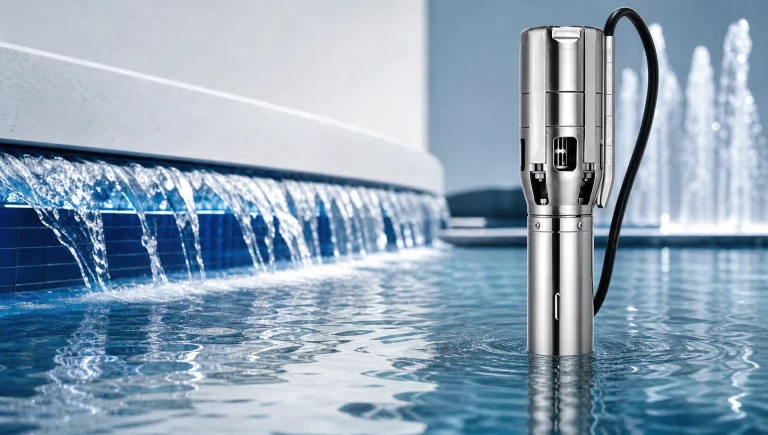
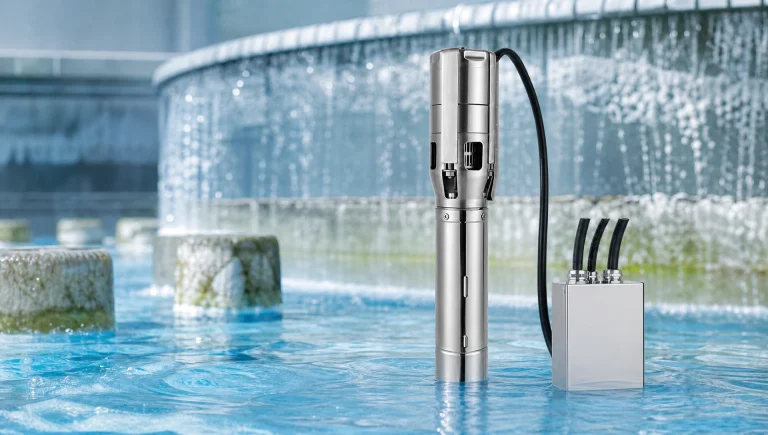
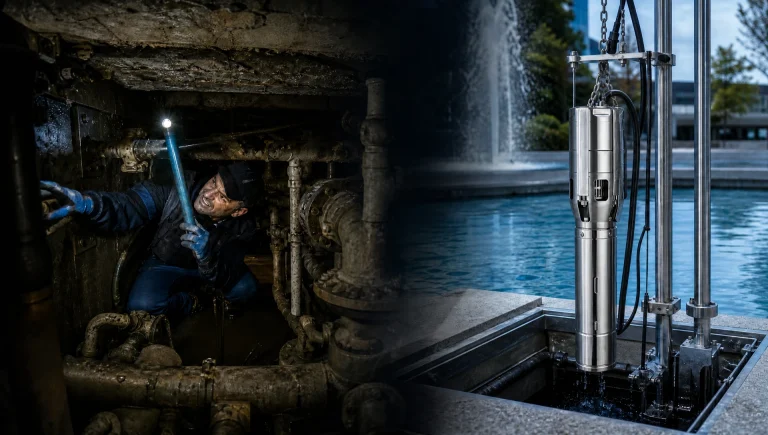
The mechanical seal is the most fragile link in traditional high-pressure pumps—it is essentially a compromise that lets the shaft pass through a stationary wall, making friction-pair wear and dry-run burnout almost inevitable. To permanently say goodbye to seal replacement, the only way out is to keep water out entirely: a submersible pump represented by the submersible pump technology uses a fully enclosed motor, with no mechanical seal between the shaft and the water at all. The shaft is not exposed, water cannot seep in, and the motor cavity is fully sealed and waterproof—eliminating the biggest failure source of water ingress short-circuits. For projects that replace seals several times a year, this simply strikes one item off the maintenance checklist.
Conclusion & Selection Advice
As the technical analysis and international case studies in this article show, mechanical seal failure does not have to be managed reactively. A fully submerged architecture such as the submersible pump technology removes the root cause at the design stage: Zero-Leak Operation (No frequent shutdowns for seal replacement; maintenance cost drops significantly), combined with Seal-Less Structure and IP68 Fully Sealed Motor, makes it a strong candidate for both new fountains and retrofits of existing systems.
Owners and designers are advised to run a pump-type comparison early in the project and contact submersible pump technology technical support for a project-specific selection report.
Keywords: Mechanical Seal · Seal Failure · Silicon Carbide · Dual Mechanical Seal · Seal Materials
Frequently Asked Questions (FAQ)
What is the average mechanical seal life in fountain pumps?
According to the Hydraulic Institute (HI) survey, fountain pump mechanical seals last on average only 8-14 months, versus 2-5 years for industrial clean-water pump seals—reliability just 1/3 of the industrial standard. In extreme environments such as marine salt spray, seal life can drop to 3-6 months. KSB’s accelerated life test confirmed an equivalent life of only 8.7 months for standard seals under fountain conditions.
Why do fountain pump seals fail faster than industrial pump seals?
Five dimensions attack simultaneously: particulate wear (wear rates 10-30 times over limit), chemical attack (sodium hypochlorite raises corrosion rates 3-5×), hard-water scaling (calcium/magnesium crystals score the faces), thermal shock from frequent start/stop (10-30 thermal cycles daily produce thermal-stress cracks), and vibration damage (cavitation and water hammer accelerations reaching 5-15g break face contact).
How can fountain pump mechanical seal life be extended?
Core measures: upgrade seal faces from silicon carbide/graphite to silicon carbide/silicon carbide (10+ times better corrosion and wear resistance); upgrade O-rings from NBR to FKM or FFKM (10+ times better chlorine tolerance); add pre-filtration to keep particulates under 20μm; and use dual mechanical seals with a seal-fluid system (API Plan 53). After upgrading, whole-lifecycle cost drops 40-60%.
How much does seal failure cost in total?
Average seal replacement costs $800-2,500 per pump; a medium fountain (8-12 pumps) incurs annual seal maintenance costs of $6,400-30,000. Adding downtime from seal failures, premium emergency repair charges, and piping cleaning due to seal debris contamination, total cost is 2-3 times the direct seal replacement cost. Seal failure accounts for 38% of all pump failures.
Can the submersible pump technology really prevent mechanical seal failure?
Yes. The submersible pump technology operates fully submerged, which removes the fundamental trigger of mechanical seal failure at the design level: first, Seal-Less Structure — Pump and motor fully enclosed as one unit; mechanical seal eliminated by design; second, IP68 Fully Sealed Motor — Fully waterproof cavity; no water ingress short-circuits; and third, Zero-Leak Operation — No frequent shutdowns for seal replacement; maintenance cost drops significantly. Instead of managing symptoms, these three design features make the problem structurally unlikely to occur. For project-specific sizing, contact the pump engineering specialists for a full evaluation.
Recommended Solution: submersible pump technology
The submersible pump technology is engineered for continuous fountain operation and structurally avoids the issue discussed in this article — Frequent Mechanical Seal Failure in Fountain Pumps: Annual Maintenance Costs Reach 20-30% of Pump Price:
- Seal-Less Structure: Pump and motor fully enclosed as one unit; mechanical seal eliminated by design
- IP68 Fully Sealed Motor: Fully waterproof cavity; no water ingress short-circuits
- Zero-Leak Operation: No frequent shutdowns for seal replacement; maintenance cost drops significantly
Need sizing or engineering support for your project? Contact the the manufacturer through official channels for submersible pump technology technical documentation and project assistance.