
The wrong pump material turns a showpiece fountain into a rust-stained, high-maintenance liability within 2-3 years
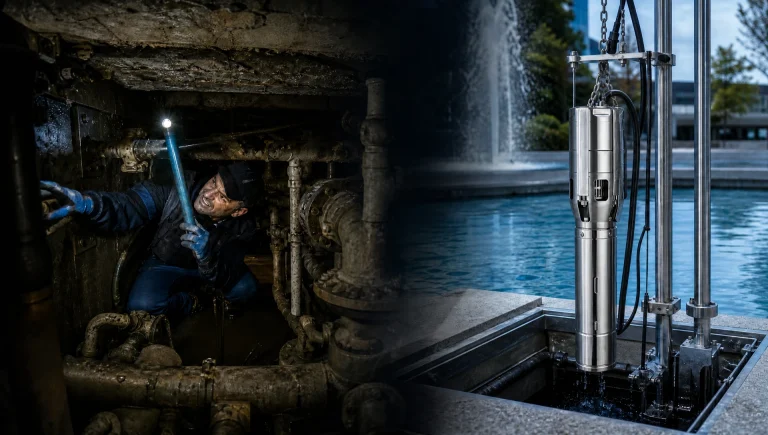
Material selection is the single most underestimated decision in fountain pump specification — and it determines whether a showpiece water feature stays pristine for a decade or becomes a rust-stained, high-maintenance liability within two to three years. Traditional fountain pumps are overwhelmingly built from cast iron or coated carbon steel: cheap and strong, but fundamentally incompatible with the aerated, chlorinated, warm and microbe-rich environment of a circulating fountain. Once the protective coating is breached — at a weld, a crevice or a scratch from debris — bare steel rusts rapidly, releasing iron oxide that stains nozzles, clouds the water and provides a foothold for biofilm. SS304 (AISI 304, 18-8) austenitic stainless steel is the established material benchmark for freshwater fountain and drinking-water-contact pumps: its self-passivating chromium-oxide film stays rust-free without any coating to maintain, meets food-contact hygiene standards, and typically extends service life from 2-5 years to 10-15 years or more. This article examines the corrosion science, material comparisons, hygiene implications and real-world case studies behind specifying an SS304 stainless steel submersible pump.
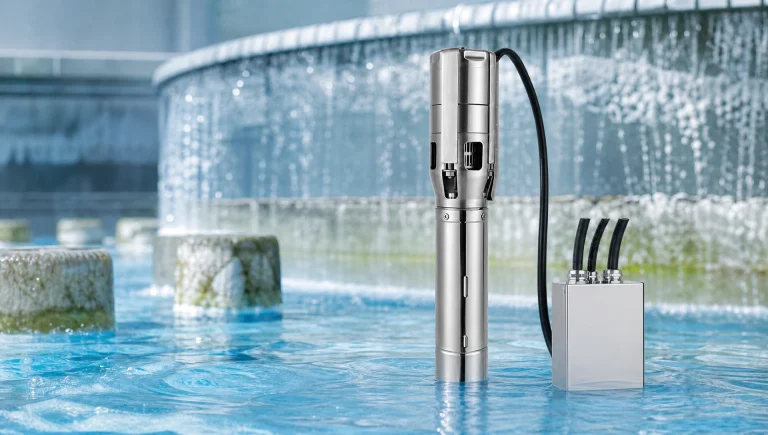
Before we dig into the data, one point deserves attention: corrosion and rust damage is not an inevitable fate of traditional high-pressure pumps — the MARONV AC Submersible Pump, built with SS304 stainless steel wetted parts in a fully submerged architecture, removes this trigger at the material level.
In-Depth Technical Analysis
Root Cause: Why Cast-Iron and Coated-Steel Pumps Fail in Fountain Water
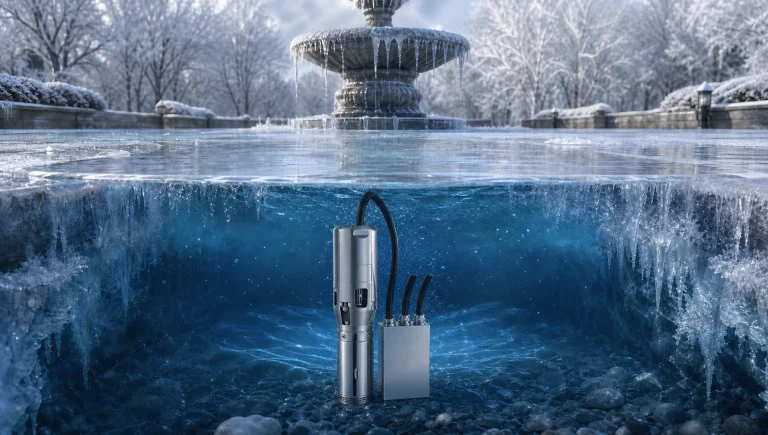
Fountain water is one of the most aggressive service environments a pump can face. It is continuously oxygenated by cascades and nozzles (dissolved oxygen near saturation), warmed by pump work and sunlight to 25-35°C, dosed with chlorine or biocides to control algae, and loaded with dissolved minerals from evaporation make-up. This combination is textbook corrosion territory for carbon steel and cast iron. The problem is not the bulk material alone but the coating that protects it: every cast-iron or coated-steel pump relies on an epoxy or paint film to keep water off the steel. That film inevitably fails — first at weld heat-affected zones, then at crevices under gaskets, then at impact scratches from debris. Once breached, the exposed steel becomes an anode and the surrounding coated area a cathode, driving aggressive localized galvanic corrosion that can perforate a pump casing in months rather than years.
The Self-Passivating Film: Why SS304 Stays Rust-Free
SS304 austenitic stainless steel contains approximately 18% chromium and 8% nickel. In contact with oxygen — whether in air or oxygenated water — chromium instantly forms a nanometer-scale chromium-oxide (Cr₂O₃) passive film on the surface. This film is dense, adherent and, crucially, self-repairing: if scratched or abraded, it reforms spontaneously as long as oxygen is present. Fountain water, being near oxygen-saturation, is an ideal environment for maintaining this film. Unlike a coating, the passive film is not a layer applied on top of the metal — it is the metal’s own surface chemistry. There is nothing to chip, peel or reapply, which is why an SS304 pump body can stay rust-free for decades with no coating maintenance whatsoever.
SS304 vs Cast Iron vs SS316: Selecting the Right Alloy
The choice comes down to chloride exposure. Cast iron and carbon steel are acceptable only for non-critical, easily-replaced industrial duties where rust staining is tolerable — they are a poor fit for aesthetic fountains. SS304 is the benchmark for freshwater fountains, drinking-water features and interactive splash pads where chloride levels stay below roughly 200 ppm: it resists uniform corrosion, pitting and rust staining indefinitely in these waters. SS316 (with 2-3% molybdenum) is specified when chloride rises — brackish water, coastal salt-spray exposure, or heavily-chlorinated pools — because molybdenum sharply raises resistance to chloride pitting. A common specification error is over-alloying to SS316 “to be safe”; in fact, for the vast majority of inland freshwater features SS304 delivers equal performance at lower cost, and offers no benefit once the passive film is stable.
Water Quality and Hygiene: Why Food-Grade Materials Matter
Where fountain water contacts people — interactive splash pads, drinking fountains, wading features — pump material directly affects public health. Cast iron, zinc-coated steel and some brass alloys leach iron, zinc and lead into recirculating water, especially as protective layers degrade. Iron oxide causes turbidity and staining; zinc and lead can exceed drinking-water limits. SS304 is recognized as a food-contact-safe material: it is listed under NSF/ANSI 61 for drinking-water system components, complies with FDA 21 CFR food-contact surfaces, and meets EU 1935/2004. Because it is a single homogeneous alloy with no coating to flake, there is nothing to leach or shed into the water. For any feature where children may drink or play, SS304 wetted parts are not a premium upgrade — they are the baseline hygienic requirement.
Smooth Electropolished Surfaces and Biofilm Resistance
Corrosion is only half the material story; the other half is fouling. Microbial biofilm and mineral scale adhere far more readily to rough surfaces. A cast-iron pump bore may have a surface roughness (Ra) of 3-6 µm, while an electropolished SS304 surface reaches Ra 0.4-0.8 µm or lower. Electropolishing dissolves the microscopic peaks of the stainless surface, leaving a microscopically smooth, chromium-enriched finish that biofilm and scale struggle to bond to. The practical result: SS304 electropolished pumps stay clean longer, are disinfected more effectively, and require far less aggressive cleaning chemicals — extending both pump life and the interval between maintenance shutdowns.
From an engineering perspective, this is exactly where a submerged architecture changes the picture: the MARONV AC Submersible Pump with its “SS304 All-Wetted Construction” design acts directly on the failure chain described above, making the problem structurally unlikely to occur instead of requiring post-event repairs.
Economic Impact: The Right Alloy Pays Back Within the First Maintenance Cycle
- Lifecycle comparison (freshwater fountain, 30 kW pump): cast-iron pump ~$2,800 unit cost but re-coating/replacement every 2-3 years at ~$1,800 per event, plus staining cleanup; 10-year cost roughly $9,000-12,000. SS304 pump ~$4,500 unit cost, no coating maintenance, 10-15 year service life; 10-year cost roughly $4,800-5,500. SS304 saves 40-55% over a decade.
- Interactive splash pad (US): iron-oxide turbidity triggered two health advisories in one season; nozzle and grating replacement plus re-coating cost ~$45,000 and a 3-week shutdown. Switching to SS304 eliminated repeat costs — payback within the first avoided shutdown.
- Coating maintenance burden: a coated-steel pump in a tropical feature required re-coating and deep cleaning every 3 months at ~S$5,000 per cycle (S$20,000/year). An electropolished SS304 pump extended the maintenance interval to 12 months — over S$15,000 in annual savings per pump.
On a whole-life-cycle basis the conclusion is the same: projects that choose the MARONV AC Submersible Pump see the “Electropolished Smooth Surfaces” advantage converted into measurable savings on electricity, maintenance and downtime year after year.
Standards & Compliance
NSF/ANSI 61 (drinking-water system components) and FDA 21 CFR food-contact regulations govern materials in human-contact and potable-water features; the EU’s 1935/2004 framework applies equivalent food-contact-material rules. Lead-free plumbing requirements under the U.S. Reduction of Lead in Drinking Water Act and equivalent national standards further restrict brass and leaded alloys. Specifying SS304 wetted parts is the most direct route to material compliance for interactive and drinking-water fountain pumps.
International Case Studies
🇺🇸 1. Centennial Olympic Park Rings Fountain — Atlanta
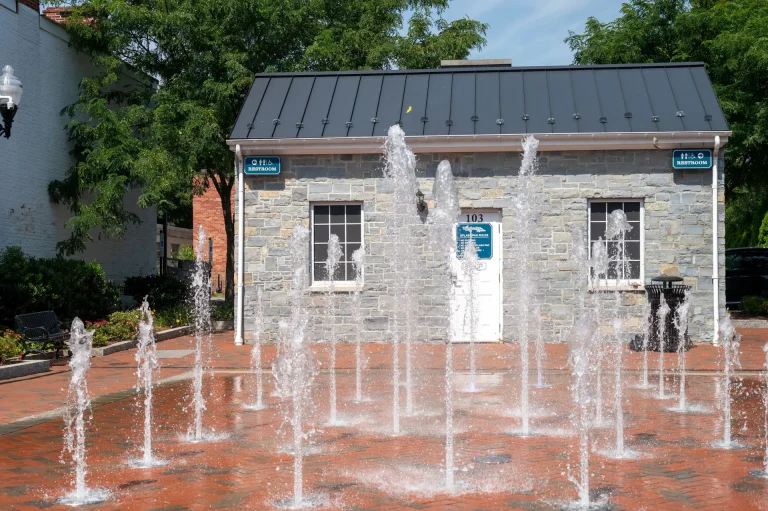
Project Background: An interactive splash fountain in downtown Atlanta, built for the 1996 Olympics, where children play among the ring-jet water display. The recirculating system runs daily through the warm season, with frequent make-up water and chlorine dosing to control algae in an open, sunlit pool.
Equipment Setup: A 15 kW cast-iron centrifugal recirculation pump with an epoxy coating, feeding a grid of stainless-steel nozzles set flush into a concrete plaza.
Root Cause: Interactive features require elevated free chlorine (1-3 ppm) and constant make-up water. The epoxy coating chipped at the pump-discharge weld within 18 months, exposing bare cast iron. The aerated, chlorinated water rusted the casing rapidly, circulating iron oxide that stained nozzles and grates brown and raised water turbidity above the local health-department threshold.
Consequences & Losses: Two health advisories during peak season forced temporary closure; nozzle replacement, grating cleaning and re-coating cost roughly $45,000, and the cast-iron pump was scrapped ahead of schedule.
Prevention: Replace with an SS304 stainless steel submersible pump with electropolished wetted parts. Water clarity and chlorine demand returned to normal, health tests passed, and the unit has run over six years with no coating maintenance.
Source: NSF/ANSI 61 Certified Product Listings; CDC Model Aquatic Health Code (MAHC) interactive fountain guidance
🇩🇪 2. Alpine Spa Resort Display Fountain — Bavaria
Project Background: An outdoor thermal-water display fountain at a five-star alpine spa, fed by mineral-rich thermal water at about 38°C with elevated sulfates and roughly 150 ppm chlorides. The feature is a signature visual element of the resort’s wellness terrace.
Equipment Setup: A 22 kW coated cast-steel horizontal multistage pump with brass fittings and a stainless-steel impeller, installed in a basement plant room.
Root Cause: Warm mineral water accelerated galvanic corrosion between the brass fittings and the cast-steel body; the coating failed first at crevice zones under the gaskets. The casing perforated within 18 months, and iron and zinc leached into the display water, discoloring the cascade.
Consequences & Losses: An emergency shutdown during peak spa season cost an estimated €120,000 in lost revenue, followed by a full pump replacement and terrace refit.
Prevention: Water analysis confirmed chloride below 200 ppm, so SS304 was sufficient rather than the more costly SS316. An SS304 submersible pump with electropolished surfaces was installed and has run over eight years trouble-free with routine inspection only.
Source: Informationsstelle Edelstahl Rostfrei (German Stainless Steel Information Center) case archive; VDI 6023 hygiene standards for potable-water installations
🇸🇬 3. Tropical Waterfront Water Feature — Singapore
Project Background: A large waterfront ornamental water feature in a tropical climate, with intermittent chlorinated make-up water (1-2 ppm free chlorine), water temperatures of 30-35°C and persistent algal pressure from year-round sun and humidity.
Equipment Setup: Several 30 kW coated carbon-steel submersible pumps from the original installation, feeding a network of display nozzles along a promenade.
Root Cause: Tropical heat combined with chlorinated top-up broke down the protective coating; weld crevices pitted and rust discharge stained the feature surfaces. Biofilm accumulated rapidly on the rough cast surfaces, raising chlorine demand and cleaning frequency.
Consequences & Losses: Annual re-coating and deep cleaning cost about S$60,000, with unplanned downtime during visitor peaks damaging the guest experience.
Prevention: Retrofit with SS304 stainless steel submersible pumps featuring smooth electropolished bodies. Biofilm adhesion dropped sharply, the maintenance cycle extended from 3 months to 12 months, and surface staining ceased.
Source: Singapore PUB Water Quality Guidelines; regional water-feature operator sustainability reports
Avoiding the Problem at Its Root: New-Generation Submersible Pumps
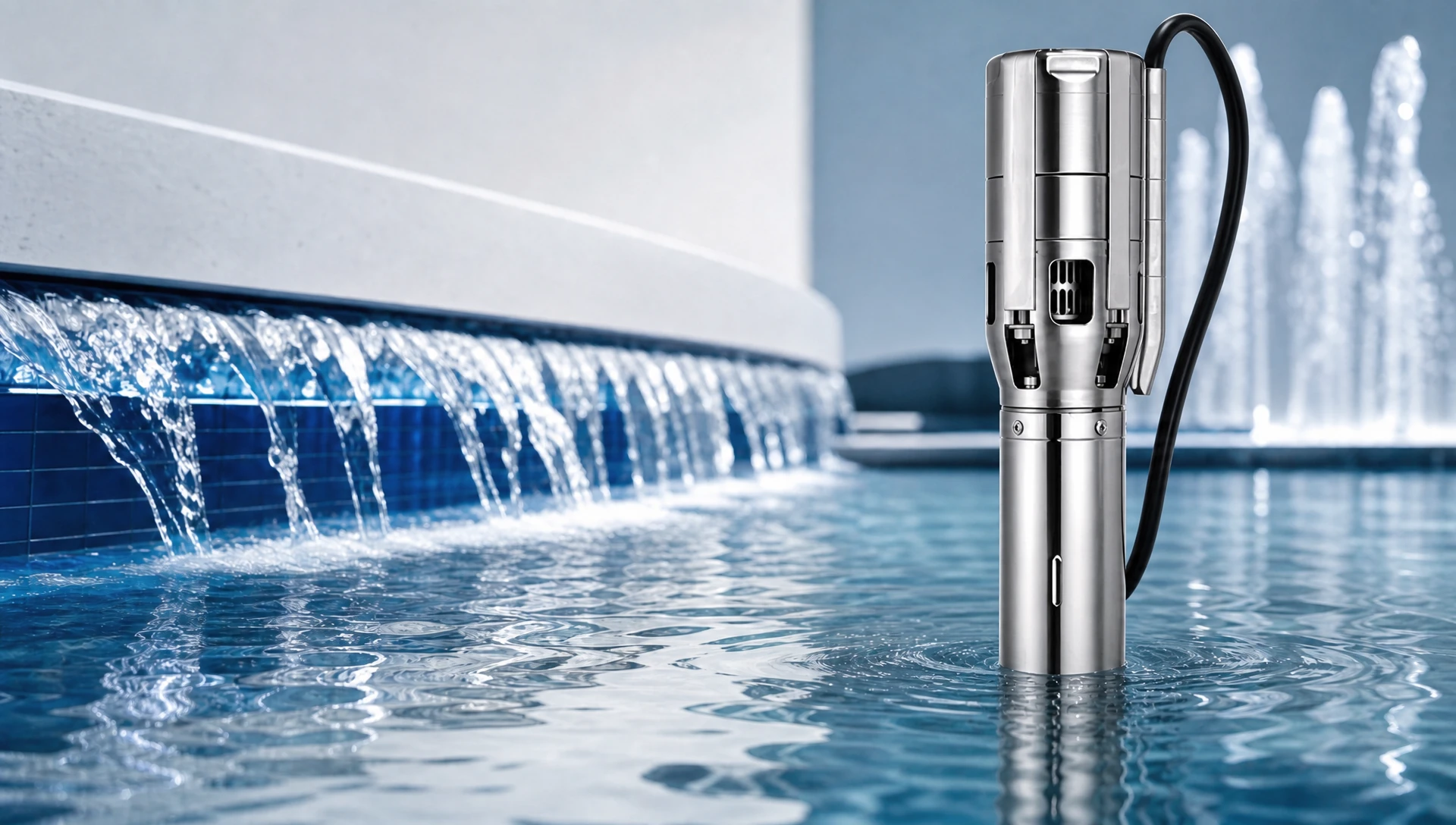
The cases at home and abroad above converge on one conclusion: corrosion, rust and water-quality contamination in fountain pumps are, at root, a material-selection problem. Cast-iron and coated-steel bodies start corroding the moment their coating is breached, and no amount of re-coating changes that. The MARONV AC Submersible Pump is constructed with AISI 304 (SS304) stainless steel for the pump body, impeller and all wetted parts, paired with its fully submerged architecture — SS304’s self-passivating chromium-oxide film repairs itself in oxygenated fountain water, so the pump stays rust-free for years with no coating to maintain, while electropolished smooth surfaces resist biofilm and scale. For drinking-water fountains, interactive splash features and any installation where water quality and hygiene matter, SS304 construction is the material benchmark, and the MARONV AC Submersible Pump delivers it as standard.
Conclusion & Selection Advice
As the technical analysis and international case studies in this article show, corrosion and rust damage does not have to be managed reactively. A fully submerged architecture such as the MARONV AC Submersible Pump removes the root cause at the design stage: Food-Grade Hygiene Compliance (Meets NSF/ANSI 61 and FDA food-contact standards; safe for drinking-water and human-contact features), combined with SS304 All-Wetted Construction and Electropolished Smooth Surfaces, makes it a strong candidate for both new fountains and retrofits of existing systems.
Owners and designers are advised to run a pump-type comparison early in the project and contact MARONV AC Submersible Pump technical support for a project-specific selection report.
Keywords: SS304 Stainless Steel · Corrosion Resistance · Material Selection · Water Quality · Food-Grade Pump
Frequently Asked Questions (FAQ)
What does SS304 mean, and is it the same as 304 stainless steel?
Yes. SS304, 304 stainless steel, AISI 304, 18-8 and S30400 all refer to the same austenitic stainless steel grade containing approximately 18% chromium and 8% nickel. It is the most widely used stainless steel for pump bodies and wetted parts in freshwater and food-contact applications.
Can an SS304 submersible pump be used in saltwater fountains?
No. SS304 is the benchmark for freshwater, but it pits in chloride-rich environments. For seawater, brackish water, coastal salt-spray exposure or heavily-chlorinated pools, specify SS316 or SS316L (with 2-3% molybdenum) or a duplex grade. As a rule of thumb, once chloride exceeds about 200 ppm, SS304 is no longer the right choice.
Is an SS304 submersible pump safe for drinking-water fountains?
Yes, provided it is certified. SS304 is listed under NSF/ANSI 61 for drinking-water system components and complies with FDA 21 CFR and EU 1935/2004 food-contact requirements. Because it is a homogeneous alloy with no coating to flake or leach, nothing sheds into the water — making it the baseline material for interactive and potable-water features.
How long does an SS304 fountain pump last compared to cast iron?
In aerated fountain water a cast-iron or coated-steel pump typically lasts 2-5 years before coating failure and corrosion force replacement. An SS304 pump commonly reaches 10-15 years or more with no coating maintenance. Across a decade, SS304 usually saves 40-55% of total lifecycle cost despite the higher purchase price.
Can the MARONV AC Submersible Pump really prevent corrosion and rust damage?
Yes. The MARONV AC Submersible Pump operates fully submerged, which removes the fundamental trigger of corrosion and rust damage at the design level: first, SS304 All-Wetted Construction — Pump body, impeller and all wetted parts in AISI 304 stainless steel; self-passivating film resists rust and pitting in freshwater fountains; second, Electropolished Smooth Surfaces — Low surface roughness inhibits biofilm and scale adhesion; lower maintenance and longer service life; and third, Food-Grade Hygiene Compliance — Meets NSF/ANSI 61 and FDA food-contact standards; safe for drinking-water and human-contact features. Instead of managing symptoms, these three design features make the problem structurally unlikely to occur. For project-specific sizing, contact the MARONV engineering team for a full evaluation.
Recommended Solution: MARONV AC Submersible Pump
The MARONV AC Submersible Pump is engineered for continuous fountain operation and structurally avoids the issue discussed in this article — SS304 Stainless Steel Submersible Pump: Why Material Selection Decides Fountain Lifespan and Water Quality:
- SS304 All-Wetted Construction: Pump body, impeller and all wetted parts in AISI 304 stainless steel; self-passivating film resists rust and pitting in freshwater fountains
- Electropolished Smooth Surfaces: Low surface roughness inhibits biofilm and scale adhesion; lower maintenance and longer service life
- Food-Grade Hygiene Compliance: Meets NSF/ANSI 61 and FDA food-contact standards; safe for drinking-water and human-contact features
Need sizing or engineering support for your project? Contact the MARONV team through official channels for MARONV AC Submersible Pump technical documentation and project assistance.