
Table of Contents
The hidden killer of musical fountains—pressure waves can reach 2.5-3× normal pressure in an instant
Water hammer (hydraulic shock) is one of the most destructive phenomena in fluid mechanics. Per the definition, water hammer is a pressure surge produced when flowing fluid is forced to stop or change direction suddenly, causing problems ranging from noise and vibration to pipe rupture. In musical fountains, multiple zone valves frequently open and close almost simultaneously to keep pace with the music, making water hammer especially severe and complex.
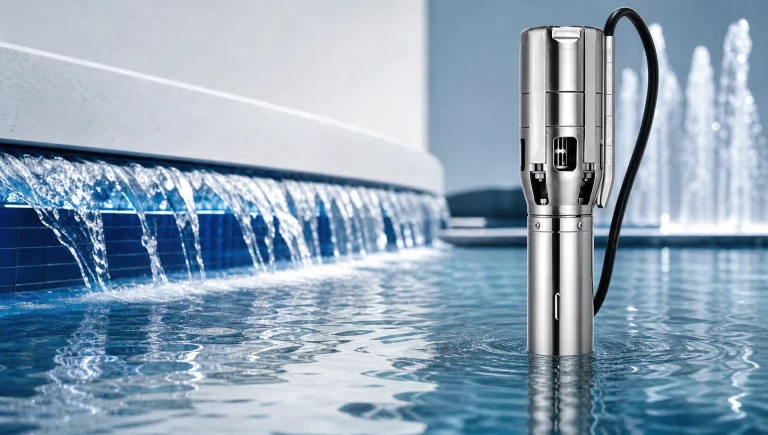
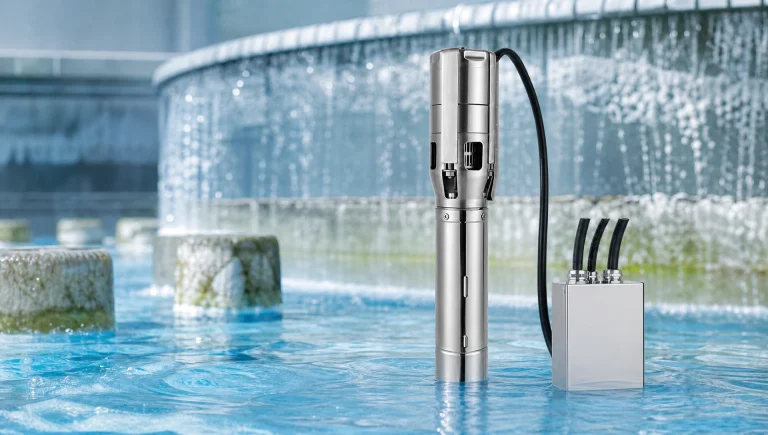
water hammer is not an inevitable fate of traditional high-pressure pumps — the MARONV AC Submersible Pump, with its fully submerged architecture, removes this trigger at the design stage.
In-Depth Technical Analysis
The Physics: “Pressure Waves” in Piping
The physical mechanism of water hammer is described quantitatively by the Joukowsky equation: ΔP = ρ × c × ΔV, where ΔP is the sudden pressure rise, ρ is fluid density (about 1,000kg/m³ for water), c is the pressure-wave velocity in water (about 1,200-1,400m/s), and ΔV is the instantaneous change in flow velocity. An engineering example: for a DN200 steel pipe with a flow velocity of 2.0m/s, if the valve closes in 0.5 seconds, the instantaneous pressure rise can reach 2.4MPa (about 24bar)—2.5-3.0 times the system’s normal working pressure.
Standing-Wave Superposition of Synchronized Multi-Valve Action
To keep pace with the music, musical fountains often need multiple zone valves to open and close rapidly at almost the same instant (within 50ms of each other). When pressure waves from several closing valves meet and superimpose at the same point in the piping, peak pressure can reach 2-3 times that of a single water hammer event. Such superposition effects are completely unpredictable in traditional single-valve water hammer analysis.
Hundreds of Fatigue Impacts Every Day
Each musical fountain performance can involve 10-30 rapid valve actions, and 4-8 shows per day means 40-240 water hammer impacts daily. Hundreds of pressure pulses per day form a fatigue load. A single impact may not cause immediate damage, but after months or even years of accumulation, microcracks develop at stress-concentration sites such as welds, elbows and diameter changes, and gradually propagate until sudden failure.
Reflection Superposition in Long Piping Systems
Fountain piping can run hundreds of meters. Pressure waves reflect back from pipe ends (pool or dead-end) toward the valve position; if the reflected wave aligns in phase with pressure waves generated by subsequent valve actions, a resonance amplification effect occurs. This resonant water hammer is often overlooked at the system design stage.
From an engineering perspective, this is exactly where a submerged architecture changes the picture: the MARONV AC Submersible Pump with its “Extremely Short Piping” design acts directly on the failure chain described above, making the problem structurally unlikely to occur instead of requiring post-event repairs.
Design Code Recommendations
- ASME B31.3 Process Piping: recommends a design flow velocity not exceeding 1.5m/s (especially recommended for fountain systems).
- AWWA M51 Water Hammer Control Handbook: valve closing time should be at least 10 times the pressure-wave round-trip time, i.e., T_close ≥ 10 × (2L/c).
- Estimation example: for a line of L=200m and c=1,200m/s, pressure-wave round-trip time = 2×200/1200 ≈ 0.33s, so the recommended closing time is ≥3.3s.
- Synchronized multi-valve action scenarios must undergo transient analysis to identify standing-wave superposition and resonance amplification risks.
On a whole-life-cycle basis the conclusion is the same: projects that choose the MARONV AC Submersible Pump see the “VFD Soft Start/Stop” advantage converted into measurable savings on electricity, maintenance and downtime year after year.
Standards & Compliance
Running full-duty transient simulations with professional software such as Bentley HAMMER or AFT Impulse at the design stage is the most effective means of preventing water hammer accidents. Singapore’s Marina Bay Sands invested about $50,000 in simulation analysis at the design stage, avoiding a potential $500,000+ accident loss.
International Case Studies
🇦🇪 1. Dubai Mall Indoor Waterfall — Water Hammer Flooding Accident
Project Background: Dubai Mall houses the world’s tallest indoor waterfall (24m drop), combined with jumping-jet water shows as the mall’s core attraction. The waterfall circulation piping crosses multiple building levels, including public areas, above stores and through parking.
Equipment Setup: DN250 stainless steel main pipe, multiple fast-acting solenoid valves (response time <0.5s), several circulation pumps totaling about 400kW. Total piping length exceeds 300m.
Root Cause: Solenoid valves were configured for fast closing (closing time <0.5s), far below the safe closing time (should be ≥3.5s). Design-stage analysis was static and single-valve only; no transient simulation of coordinated multi-valve closing was performed. The water hammer arrester was undersized, designed for only 50% of a single-valve hammer’s energy.
Consequences & Losses: Superimposed water hammer from simultaneously closing valves blew out the DN250 main flange gaskets instantly, discharging about 300m³/h of high-pressure water. The flood submerged three premium brand stores below (including Louis Vuitton and Tiffany & Co.), with losses exceeding AED 5,000,000 (about $1,360,000). The mall closed the affected area for 3 days.
Prevention: Install 6 large bladder-type water hammer arresters distributed along the piping. Apply staged closing to all valves (close to 30%, pause 1s, then close fully). Run full-duty transient simulation with Bentley HAMMER at the design stage. Install slow-closing check valves to prevent water hammer rebounding at the pump discharge.
Source: Emaar Malls Management internal incident report; Gulf News 2017 feature report; engineering insurance claims records
🇺🇸 2. Wynn Las Vegas — Pump Shaft Failure Incident
Project Background: Wynn Las Vegas is one of the most luxurious casino hotels on the Strip; its circular fountain plaza at the entrance is the hotel’s signature feature. The fountain system connects to the hotel lobby’s grand water-feature installation.
Equipment Setup: Multiple 200HP (about 150kW) horizontal centrifugal pumps, DN250 main pipe, multiple hydraulic control valves for musical-fountain water-display switching.
Root Cause: Water hammer pressure waves from fast valve closing traveled back down the piping to the pump discharge. The discharge side had a check valve, but it was a fast-response swing check valve that slammed shut the instant forward flow stopped, generating a secondary water hammer. Peak pressure reached 42bar—5.25 times the system’s normal working pressure.
Consequences & Losses: The hammer peak pressure snapped the shaft of a 200HP main pump. The flung-off impeller assembly pierced the pump casing, and flying debris damaged an adjacent VFD cabinet. Direct losses exceeded $350,000. Repairs took 3 weeks.
Prevention: Install slow-closing check valves at the pump discharge (closing time adjustable to 3-8 seconds). Use VFDs for soft start and soft stop (ramp times ≥8 seconds). Install bladder-type water hammer arresters at the pump discharge. Conduct water hammer simulation analysis during piping design.
Source: Wynn Las Vegas Engineering Incident Report (2006); Pumps & Systems Magazine case analysis
🇸🇬 3. Marina Bay Sands Hotel, Singapore — Positive Case Study
Project Background: Marina Bay Sands is Singapore’s iconic integrated resort; its exterior water features include a large fountain, artificial river and viewing-deck water screens. Opened in 2010, the fountain system was designed by WET Design.
Equipment Setup: Complete water hammer simulation analysis; all control valves set with safe closing times (minimum 3 seconds); main piping one size larger than conventional design; pressure-relief valves at every branch pipe inlet; VFD pump sets all using soft start/stop.
Root Cause: (Positive case, no incident.) The designers built a complete piping network model in Bentley HAMMER, running transient analysis for all 40 water-display zones and 20 performance modes, identifying 12 high-risk scenarios and resolving each one.
Consequences & Losses: No water hammer-related incidents in 10+ years of operation. The simulation investment of about $50,000 (design stage) avoided a potential $500,000+ accident loss.
Prevention: Run complete water hammer simulation at the design stage. Set safe closing times on all valves. Specify main piping one size larger than conventional. Fit pressure-relief valves at every branch inlet. Apply soft start/stop to VFD pump sets.
Source: WET Design Engineering Portfolio; Marina Bay Sands Facilities Management Reports; Bentley Systems case study
Avoiding the Problem at Its Root: New-Generation Submersible Pumps
Water hammer is caused by sudden changes in flow velocity inside piping, and sudden velocity changes stem from the combination of long-distance piping and abrupt start/stop. Submersible pump solutions compress this risk geometrically: take the MARONV AC Submersible Pump as an example—the pump is installed directly in the fountain pool with extremely short discharge piping, drastically reducing both the propagation distance and destructive energy of hammer waves; combined with VFD soft start/stop, the pump set ramps up and down smoothly along a set slope, with smooth pressure fluctuation and no impact. For projects that have experienced pipe bursts and valve damage, this combination of short piping and soft start/stop is precisely the right prescription.
Conclusion & Selection Advice
As the technical analysis and international case studies in this article show, water hammer does not have to be managed reactively. A fully submerged architecture such as the MARONV AC Submersible Pump removes the root cause at the design stage: Cushioned Check Valve Optional (Further absorbs residual pressure fluctuation in the piping), combined with Extremely Short Piping and VFD Soft Start/Stop, makes it a strong candidate for both new fountains and retrofits of existing systems.
Owners and designers are advised to run a pump-type comparison early in the project and contact MARONV AC Submersible Pump technical support for a project-specific selection report.
Keywords: Water Hammer · Pipe Burst · Pressure Wave · Transient Analysis · System Safety
Frequently Asked Questions (FAQ)
What is water hammer?
Water hammer is a pressure surge produced when flowing fluid is forced to stop or change direction suddenly. Its magnitude is calculated by the Joukowsky equation: ΔP = ρ × c × ΔV. For a DN200 steel pipe at 2.0m/s flow velocity, a 0.5-second valve closing can generate 24bar of instantaneous pressure—2.5-3 times normal working pressure—enough to blow out flange gaskets and rupture pipes.
Why is water hammer especially severe in musical fountains?
Musical fountains need multiple zone valves to open and close rapidly at almost the same instant (within 50ms) to keep pace with the music. Pressure waves from simultaneously closing valves superimpose, and peak pressure can reach 2-3 times a single hammer event. With 40-240 hammer impacts every day forming fatigue loads, microcracks develop at stress-concentration sites in the piping.
How can fountain water hammer accidents be prevented?
Core measures: run full-duty transient simulation with professional software such as Bentley HAMMER at the design stage; set safe closing times on all valves (≥10 times the pressure-wave round-trip time); install large bladder-type water hammer arresters distributed along the piping; fit slow-closing check valves at the pump discharge; apply soft start/stop to VFD pump sets (ramp times ≥8 seconds); and size main piping one size larger to reduce flow velocity.
How much do water hammer accidents typically cost?
The Dubai Mall indoor waterfall hammer accident caused flooding losses over $1,360,000; water hammer snapped a pump shaft at Wynn Las Vegas with losses over $350,000. By contrast, Marina Bay Sands in Singapore invested $50,000 in simulation analysis at the design stage, operated 10 years without a single hammer incident, and avoided a potential $500,000+ loss.
Can the MARONV AC Submersible Pump really prevent water hammer?
Yes. The MARONV AC Submersible Pump operates fully submerged, which removes the fundamental trigger of water hammer at the design level: first, Extremely Short Piping — Pump connects directly to nozzles; short hammer-wave path and low energy; second, VFD Soft Start/Stop — Ramps up and down along a set slope; smooth, impact-free pressure fluctuation; and third, Cushioned Check Valve Optional — Further absorbs residual pressure fluctuation in the piping. Instead of managing symptoms, these three design features make the problem structurally unlikely to occur. For project-specific sizing, contact the MARONV engineering team for a full evaluation.
Recommended Solution: MARONV AC Submersible Pump
The MARONV AC Submersible Pump is engineered for continuous fountain operation and structurally avoids the issue discussed in this article — Fountain Water Hammer (Water Hammer): The Direct Driver of Pipe Bursts and Equipment Damage:
- Extremely Short Piping: Pump connects directly to nozzles; short hammer-wave path and low energy
- VFD Soft Start/Stop: Ramps up and down along a set slope; smooth, impact-free pressure fluctuation
- Cushioned Check Valve Optional: Further absorbs residual pressure fluctuation in the piping
Need sizing or engineering support for your project? Contact the MARONV team through official channels for MARONV AC Submersible Pump technical documentation and project assistance.