
Table of Contents
Electricity for traditional high-pressure centrifugal pumps accounts for 60-80% of a fountain’s total operating costs. A 100kW system in China can incur annual electricity bills exceeding 230,000 CNY; in the US, a 500kW fountain costs $400,000-600,000 per year. The root cause is a fundamental mismatch: pumps designed for continuous industrial duty at a constant operating point cannot efficiently serve fountain systems that require constantly changing flow and head.
The energy consumption of traditional centrifugal pumps in fountain water features is the most critical pain point facing the entire industry. Statistics show that pump system electricity accounts for 60-80% of a fountain’s total operating costs—the largest recurring expense for operators. A fountain pump system with 100kW of installed capacity can run up annual electricity bills of over 230,000 CNY, and cumulative electricity costs over 10 years can reach 2-3 times the initial investment. The root cause: centrifugal pumps designed for continuous industrial duty at a constant operating point are fundamentally “mismatched” with fountain systems that require constantly changing flow and head.
excessive energy consumption is not an inevitable fate of traditional high-pressure pumps — the submersible pump technology, with its fully submerged architecture, removes this trigger at the design stage.
In-Depth Technical Analysis
Root Cause: The Natural “Mismatch” Between Centrifugal Pumps and Fountain Systems
Traditional centrifugal pumps are designed for industrial constant-duty water transfer, with their best efficiency point (BEP) confined to a narrow range near the rated duty point. Fountain systems are exactly the opposite—they require constantly changing flow and head to create different water displays. This natural mismatch is the fundamental reason fountain energy consumption stays stubbornly high.
Pump Type Comparison: Centrifugal vs VFD vs PMSM Submersible
The “Over-Horsepower” Problem of Fixed-Speed Operation
Traditional line-frequency pumps have only two states: on or off. Sizing must be based on the flow and head required at maximum spray height (which may be used only a few seconds per show), yet more than 90% of operating time is spent in low-spray mode (spray height at only 20-50% of maximum). The pump then runs far from its BEP in a low-efficiency zone, wasting more than 50% of energy. A 75kW pump sized for 80m head and 500m³/h flow may operate at less than 40% actual efficiency when delivering only 20m head—while the motor still draws near rated power.
Induction Motor Efficiency Troughs
Standard three-phase induction motors are most efficient near rated load (IE3 class: 92-94%), but efficiency falls sharply under partial load. In the typical 40-60% load range of fountain operation, motor efficiency drops to 80-85%; older IE1/IE2 motors deliver only 65-72% at light load. This means a significant portion of electrical energy is dissipated as heat into the motor and the environment.
Pump systems account for nearly 20% of the world’s electrical energy demand and are the single largest electrical energy end-use application in industry.
Hydraulic Institute, 2024 Pump Systems Matter Report
Hydraulic Losses from Valve Throttling
A fixed-speed pump cannot modulate flow, so excess flow and head must be “choked off” by control valves. This artificially added local resistance converts hydraulic energy into heat dissipated in the water. For a 100kW fountain system, continuous throttling losses can reach 20-40kW—equivalent to wasting 480-960 kWh of electricity every day—while the added heat also raises circulating water temperature and further worsens pump operating conditions.
Additional Resistance in Piping Systems
Fountain piping is characterized by long runs, numerous bends and many branches. A line from the pump room to the farthest nozzle may wind for hundreds of meters, passing through dozens of elbows and diameter changes. Friction plus local losses usually total 20-35% of the pump’s total head, versus 10-15% for typical industrial clean-water systems. This resistance contributes no aesthetic value whatsoever—it is purely the price paid to keep the piping network circulating.
From an engineering perspective, this is exactly where a submerged architecture changes the picture: the submersible pump technology with its “Zero-Suction Direct Feed” design acts directly on the failure chain described above, making the problem structurally unlikely to occur instead of requiring post-event repairs.
Economic Impact: Electricity Is the Operator’s Biggest Pain
- China scenario: 100kW installed capacity, 8 hours/day operation, electricity at 0.8 CNY/kWh → annual power cost = 100×8×365×0.8 = 233,600 CNY. Against an initial fountain investment of about 800,000-1,500,000 CNY, 10-year cumulative electricity costs reach 2-3 times the initial investment.
- United States scenario: According to DOE data, commercial fountains cost about $800-1,200 per kW of installed capacity per year (including demand charges). A 500kW fountain incurs annual electricity costs of $400,000-600,000.
- Europe scenario: Commercial electricity prices of 0.20-0.40 EUR/kWh (German industrial rates around 0.40 EUR) make operating costs 50-80% higher than in the US at equivalent power. Many European fountain projects are forced to reduce running hours under electricity cost pressure.
On a whole-life-cycle basis the conclusion is the same: projects that choose the submersible pump technology see the “Wide-Range VFD Speed Control” advantage converted into measurable savings on electricity, maintenance and downtime year after year.
Standards & Compliance
California’s Title 24 and ASHRAE 90.1 require mandatory energy audits for large public fountains; the EU’s EPBD sets explicit minimum energy-efficiency thresholds for fountain systems in new public buildings. Non-compliance risks penalties or operating restrictions.
International Case Studies
🇺🇸 1. Bellagio Fountain — Las Vegas
Project Background: Located at one of Las Vegas’s most iconic hotels, the front-lake musical fountain was built in 1998 on an artificial lake of about 32,000m², with more than 1,200 nozzles and 4,500 lights. Its annual operating budget is enormous, making it one of the highest energy-consuming public features on the Las Vegas Strip.
Equipment Setup: 22 main pumps (each 100HP, approx. 75kW) plus 12 auxiliary pumps, all horizontal centrifugal pumps, with a total installed capacity of about 2.2MW. The pump room lies beneath the artificial lake, covering about 7,000m². Main piping reaches DN400 at its largest diameter.
Root Cause: The pump system is entirely fixed-speed: all pumps can only run at full speed or stop, with no ability to modulate flow to match water-display requirements. The large lake area and piping exceeding 200m create significant hydraulic losses. When designed in 1998, VFD technology was costly, and Nevada had no mandatory energy-efficiency regulations at the time.
Consequences & Losses: Each 5-minute performance consumes about 183kWh, with annual electricity costs estimated at $1,500,000-2,000,000+. Electricity accounts for more than 60% of total fountain operating costs. After 2008, the operator was forced to undertake energy-saving retrofits.
Prevention: Adopt variable frequency drive (VFD) technology from the design stage to reduce energy consumption by 30-40%. Divide the pump group into multiple zones and run only part of the zone circulation pumps during off-peak hours. Optimize piping design to eliminate unnecessary elbows and length.
Source: MGM Resorts International Sustainability Reports (2019-2023); Las Vegas Review-Journal feature coverage
🇦🇪 2. Dubai Fountain — Dubai
Project Background: Located on Burj Lake beside the Burj Khalifa in Dubai, it is the world’s largest musical fountain system. The lake covers about 120,000m², spray height reaches 150m, and the system is fitted with over 6,600 lights and 25 color projectors.
Equipment Setup: Multiple high-pressure multistage centrifugal pumps with a total installed capacity of about 1.5MW. The control system manages the precise action of more than 1,000 individual nozzles, with pump discharge pressure up to 16bar.
Root Cause: Dubai summer temperatures exceed 50°C, causing extremely high circulating-water evaporation. High water temperatures (35-40°C) significantly reduce pump delivery efficiency: as water temperature rises from 20°C to 40°C, pump efficiency drops about 8-12%.
Consequences & Losses: Average monthly electricity costs run about $80,000-120,000, for annual electricity costs of about $1,000,000-1,500,000. During one 2014 performance, instantaneous power fluctuations caused some Burj Khalifa elevators to trip protective shutdowns due to voltage sags.
Prevention: Fit medium-voltage VFDs (MV VFD) combined with soft starters, install active harmonic filters, and provide a dedicated supply transformer for the fountain system. In the hot climate, upgrade motor insulation from Class F to Class H.
Source: Emaar Properties PJSC Annual Reports; Siemens Industry case study
🇸🇦 3. King Fahd Fountain — Jeddah
Project Background: The world’s tallest fountain, on the Red Sea coast of Jeddah, with a spray height of 312m. It draws Red Sea seawater directly as its water source, making it the world’s only ultra-high fountain using seawater.
Equipment Setup: 8 large horizontal multistage centrifugal pumps, each rated 375kW, for a total installed capacity of about 3MW. Piping and pump bodies use super duplex stainless steel (2507/S32750) and nickel-based alloys.
Root Cause: Multistage centrifugal pump efficiency is only 55-65% at the extreme 312m head. High seawater density increases fluid resistance. The high chloride concentration (about 19,000mg/L) is corrosive to all metallic materials.
Consequences & Losses: Annual electricity costs of about $2,000,000-3,000,000 and annual maintenance costs of about SAR 2,000,000-3,000,000. Several prolonged shutdowns around 2010 seriously damaged Jeddah’s city image.
Prevention: Prefer a multi-pump relay scheme to keep individual pump head below 100m. Apply ceramic coatings to impellers and pump casings. Install multistage filtration at the seawater intake. Configure N+1 standby pump sets.
Source: Saudi Geological Survey; Guinness World Records; Saudi Aramco Engineering Reports
Avoiding the Problem at Its Root: New-Generation Submersible Pumps
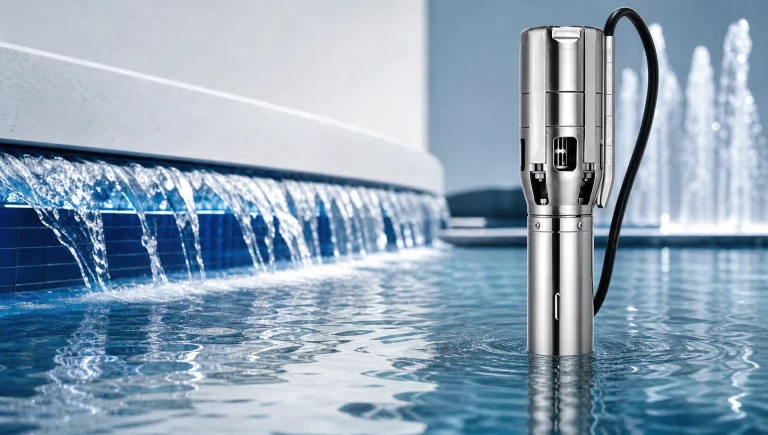
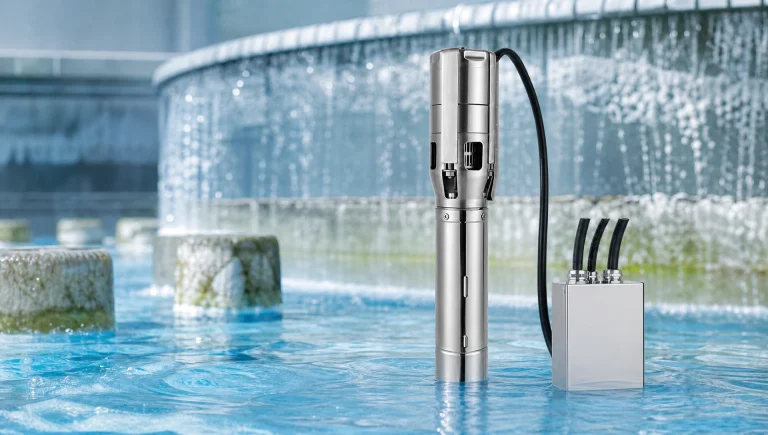
The cases at home and abroad above repeatedly confirm one fact: more than 60% of energy consumption is determined by the inherent design of the pump type and its operating mode. To break the high-energy-consumption deadlock, the most fundamental approach is to change the pump’s form itself—the underwater direct-drive solution represented by the submersible pump technology integrates the motor and pump body fully submerged in water. On one hand, it eliminates the ineffective power that traditional horizontal pumps consume to lift water columns; on the other hand, it supports wide-range variable frequency speed control—the fountain spins exactly as fast as the required spray height, eliminating full-speed, full-load waste at line frequency. For new fountains or retrofits of traditional high-pressure pumps, this type of solution is increasingly regarded by contractors as the first choice for reducing energy consumption.
Conclusion & Selection Advice
As the technical analysis and international case studies in this article show, excessive energy consumption does not have to be managed reactively. A fully submerged architecture such as the submersible pump technology removes the root cause at the design stage: High-Efficiency Hydraulic Design (Impeller and motor matched as one unit; overall efficiency exceeds split pump assemblies), combined with Zero-Suction Direct Feed and Wide-Range VFD Speed Control, makes it a strong candidate for both new fountains and retrofits of existing systems.
Owners and designers are advised to run a pump-type comparison early in the project and contact submersible pump technology technical support for a project-specific selection report.
Keywords: High Energy Consumption · Operating Cost · Variable Frequency Drive VFD · Centrifugal Pump Efficiency · Valve Throttling
Frequently Asked Questions (FAQ)
What share of total fountain operating costs does traditional high-pressure pump energy consumption account for?
According to global fountain engineering statistics, electricity for traditional high-pressure centrifugal pumps accounts for 60-80% of a fountain’s total operating costs—the operator’s largest recurring expense. A 100kW fountain pump system in China can run up annual electricity bills of over 230,000 CNY.
Why are centrifugal pumps so inefficient in fountain systems?
The root cause is that a centrifugal pump’s BEP (best efficiency point) does not match the fountain’s actual operating duty. Pumps are sized for maximum spray requirements, but more than 90% of running time is spent in low-spray mode, where efficiency can fall below 40%. In addition, valve throttling can waste 20-40kW of power.
Can a variable frequency drive (VFD) solve fountain energy consumption problems?
A VFD can cut energy use by 30-40%, but it is not a cure-all. Below 30Hz low-frequency operation, pump efficiency, motor efficiency and VFD efficiency all drop significantly, and combined efficiency can fall to just 37%. A better solution is a permanent magnet synchronous motor (PMSM) submersible pump, which maintains efficiency above 90% across the 50-100% speed range.
What regulatory requirements apply to fountain system energy efficiency?
California’s Title 24 and ASHRAE 90.1 impose mandatory energy audits on large public fountains; the EU’s EPBD sets explicit minimum energy-efficiency levels for fountain systems in new public buildings. Non-compliance risks penalties or restricted operation.
Can the Submersible Pump Technology really prevent excessive energy consumption?
Yes. The submersible pump technology operates fully submerged, which removes the fundamental trigger of excessive energy consumption at the design level: first, Zero-Suction Direct Feed — Eliminates the ineffective power of lifting water columns; lower energy per unit of flow; second, Wide-Range VFD Speed Control — Real-time speed adjustment to spray height, eliminating full-speed full-load waste at line frequency; and third, High-Efficiency Hydraulic Design — Impeller and motor matched as one unit; overall efficiency exceeds split pump assemblies. Instead of managing symptoms, these three design features make the problem structurally unlikely to occur. For project-specific sizing, contact the the manufacturer engineering team for a full evaluation.
Recommended Solution: Submersible Pump Technology
The submersible pump technology is engineered for continuous fountain operation and structurally avoids the issue discussed in this article — Fountain Energy Consumption Too High: Why Traditional High-Pressure Pumps Devour 60-80% of Operating Costs:
- Zero-Suction Direct Feed: Eliminates the ineffective power of lifting water columns; lower energy per unit of flow
- Wide-Range VFD Speed Control: Real-time speed adjustment to spray height, eliminating full-speed full-load waste at line frequency
- High-Efficiency Hydraulic Design: Impeller and motor matched as one unit; overall efficiency exceeds split pump assemblies