
Table of Contents
Electrical surges shorten equipment life, while response lag makes musical fountains fall behind the beat
Traditional centrifugal pumps use three-phase induction motors started direct-on-line (DOL), which creates two fundamental problems: large inrush current causes electrical impact, and the delay from command to water column response makes musical fountains ‘fall behind the beat.’ These two issues constrain fountain system performance in both equipment life and show quality. A 55 kW pump started DOL draws 500-700 A inrush current, 5-7 times its rated current. Meanwhile, pipe fill delay can reach 67 seconds — far exceeding the 0.5-2 second interval between musical beats.
startup impact and response lag is not an inevitable fate of traditional high-pressure pumps — the submersible pump technology, with its fully submerged architecture, removes this trigger at the design stage.
In-Depth Technical Analysis
Electrical Impact Mechanism: High Inrush Current and Mechanical Shock Torque
Traditional centrifugal pumps use three-phase induction motors started directly online (DOL). For motors above 30 kW, DOL starting current can reach 5-7 times the rated current. Even with star-delta reduced-voltage starting, starting current remains 2.5-3.5 times rated. Frequent current surges cause circuit breaker contact erosion, raise the risk of contactor contact welding, and create thermal stress accumulation in cable insulation from repeated current spikes.
Cascading Damage from High Inrush Current
Taking a 55 kW pump with 100 A rated current as an example: DOL starting draws 500-700 A inrush current lasting 1-3 seconds. Circuit breaker contact life drops from 100,000 operations to 10,000-20,000. Contactor contacts may weld from arcing. Cable insulation accumulates thermal stress from repeated current spikes.
Mechanical Shock Torque
Electromagnetic torque peaks during motor startup can reach 1.5-2.5 times rated torque. The mechanical shock transfers through the coupling to the pump shaft, imposing impact loads on the coupling elastomer, pump bearings, and impeller mounting bolts. The long-term accumulation follows a chain reaction: bolt loosening → coupling misalignment → vibration → seal failure → bearing damage.
Response Lag Mechanism: Musical Fountains ‘Fall Behind the Beat’
Musical fountains pursue ‘water-to-music synchronization’ — water column height changes must align precisely with the musical beat. But centrifugal pump systems have an unavoidable time delay from PLC command to the water column reaching its target form, including signal transmission delay (milliseconds), motor acceleration delay (0.5-3 s), pipe fill delay (7-200 s), and nozzle response delay (0.1-1 s).
Pipe Fill Delay Is the Core Bottleneck
Take a 100 m pipe from pump to nozzle: 100 m ÷ 1.5 m/s ≈ 67 s. This means that even if the motor instantly reaches target speed, it still takes 67 seconds for the effect to appear in the water column. Yet the interval between musical beats is only 0.5-2 s — the system’s response lag can reach dozens of times the musical tempo. This is a physical limitation that cannot be fully eliminated through software.
Engineering Compromise Strategies and Their Cost
To cope with response lag, engineers typically adopt a ‘main pump always running + valve switching’ approach: the main pump runs at rated speed at all times, keeping constant pressure and flow at the pump discharge, while rapidly opening and closing solenoid valves in different zones to switch water patterns. The cost: the pump still runs at rated power when the fountain is not spraying, increasing energy consumption by 30-50%. Valves undergo hundreds of high-pressure differential switching cycles per day, and their life drops from years to months. Meanwhile, rapid valve opening and closing triggers water hammer, forming a vicious cycle.
From an engineering perspective, this is exactly where a submerged architecture changes the picture: the submersible pump technology with its “Variable-frequency soft start” design acts directly on the failure chain described above, making the problem structurally unlikely to occur instead of requiring post-event repairs.
Engineering Compromise Strategies and Their Cost
- The ‘main pump always running + valve switching’ approach keeps the pump running at rated power even when the fountain is not spraying, increasing energy consumption by 30-50%.
- Valves undergo hundreds of high-pressure differential switching cycles per day, and their service life drops from years to months.
- Rapid valve opening and closing triggers water hammer effects, forming a vicious cycle.
- The synchronization accuracy between music and water patterns is insufficient; professional audiences rate it as ‘the water patterns lag visibly and integrate poorly with the music.’
On a whole-life-cycle basis the conclusion is the same: projects that choose the submersible pump technology see the “Millisecond-level response” advantage converted into measurable savings on electricity, maintenance and downtime year after year.
Standards & Compliance
Large fountain systems must be equipped with a variable frequency drive (VFD) plus soft starter combination, limiting starting inrush current to below 110% of rated current. VFD acceleration time should be set at 30 seconds or more to keep power changes gradual. Install active harmonic filters to eliminate current harmonics generated by PWM drives. Fountain systems should use a dedicated supply transformer.
International Case Studies
🇦🇪 1. Dubai Fountain — 1.5 MW Synchronized Startup Grid Impact
Project Background: The Dubai Fountain beside the Burj Khalifa is the world’s largest musical fountain system, designed by WET Design. Commissioned in 2009, its performances cover daytime and nighttime hours, synchronized with the Burj Khalifa light shows.
Equipment Setup: A high-voltage multistage centrifugal pump system totaling approximately 1.5 MW of installed capacity, with multiple large pumps rated at hundreds of kW that must start almost simultaneously at the beginning of each show.
Root Cause: The original design used direct-on-line starting; when multiple high-power pumps started simultaneously, the instantaneous current surge reached 5-7 times normal operating current. The instantaneous power demand at startup spiked from 1.5 MW to a peak of 6-10 MW. The fountain system’s supply transformer shared a grid node with the Burj Khalifa.
Consequences & Losses: During one show in 2014, the instantaneous startup power fluctuation of the fountain system caused some Burj Khalifa elevators to trip their undervoltage protection due to voltage sag (approximately 3%). Multiple elevators braked suddenly mid-run, trapping dozens of passengers in the shafts for 20-30 minutes. DEWA mandated isolation of the fountain power supply and a deadline for rectification.
Prevention: Install a VFD plus soft starter combination to limit starting inrush current to below 110% of rated current. Set VFD acceleration time to at least 30 seconds. Install active harmonic filters to eliminate harmonics. Use a dedicated supply transformer. Conduct a ‘worst-case scenario’ grid impact assessment during the design phase.
Source: Emaar Properties PJSC Technical Incident Report; Siemens Industry case study; DEWA Grid Integration Standards
🇺🇸 2. Bellagio — Thermal Fatigue from Frequent Start-Stop of 300 HP Motors
Project Background: The Bellagio fountain’s 22 main pumps are each 300 HP (approximately 225 kW). Each show lasts about 5 minutes, with 12-15 shows per day. Including rehearsals and maintenance tests, each main pump experiences 15-20 starts per day.
Equipment Setup: 300 HP three-phase induction motors, rated current approximately 350 A, DOL starting current approximately 2,000-2,500 A (about 7x). IE2 efficiency class.
Root Cause: Total starting current of 4,000-6,000 A per day continuously stresses the grid. Frequent start-stop cycles subject the motor windings to severe thermal cycling: at each start, winding temperature surges from 35°C to 120°C within 30 seconds, a temperature differential of 85°C. The thermal expansion mismatch between copper windings and insulation varnish produces sustained shear stress, and micro-cracks appear in the insulation.
Consequences & Losses: After 3-5 years of operation, several motors developed loose stator winding ends. Repair cost for a single 300 HP motor is approximately $25,000 each. Some main pumps were replaced with permanent magnet synchronous motors (PMSM), at about $45,000 each, with a combined payback period of about 4 years.
Prevention: Replace induction motors with permanent magnet synchronous motors (PMSM) to eliminate rotor heating issues. Use VFD soft start (acceleration time of at least 30 seconds) to reduce thermal shock. Apply VPI reinforcement of stator winding ends on existing motors. Conduct periodic insulation resistance tests and partial discharge testing.
Source: MGM Resorts Engineering Maintenance Records; IEEE Transactions on Industry Applications
🇨🇳 3. Shenzhen OCT Bay — Engineering Compromise on Music Synchronization
Project Background: The Shenzhen OCT Bay Water Show Theater is the largest multimedia water show project in South China, staging 2-3 large water shows every evening. The fountain must precisely synchronize with music, projection, and lasers.
Equipment Setup: Traditional centrifugal pump set with VFD control system; the main pipeline runs approximately 120 m from the pump room to the farthest nozzle.
Root Cause: With a 120 m pipeline plus the water column height differential, the total delay from command to visible water column response is about 5-7 seconds, while the musical beat interval is only 0.5-2 s. The system cannot achieve true ‘music synchronization’ and can only use ‘predictive control’ to anticipate the music beat several seconds in advance. The constant-pressure holding strategy keeps the system consuming about 30% of rated power during non-spray periods.
Consequences & Losses: The synchronization accuracy between music and water patterns is insufficient, and audience satisfaction scores are low. The constant-pressure holding strategy increases annual electricity costs by approximately RMB 600,000-800,000. Multiple attempts to improve synchronization through optimized control algorithms have had limited effect — the physical bottleneck lies in the pipeline length and the fluid inertia of the water column.
Prevention: Locate the pump room as close to the fountain performance area as possible, keeping main pipeline length within 50 m. Adopt a distributed pump set solution. Use fast-response solenoid valves combined with pressurized accumulators. The most thorough solution is distributed submersible pumps with independent control — each nozzle driven directly by its own submersible pump. Disney’s ‘World of Color’ uses 400+ small submersible pumps based on this same logic.
Source: Shenzhen OCT Harbour operator internal technical summary; China Entertainment Equipment Technology Association Water Show Division exchange materials
Avoiding the Problem at Its Root: New-Generation Submersible Pumps
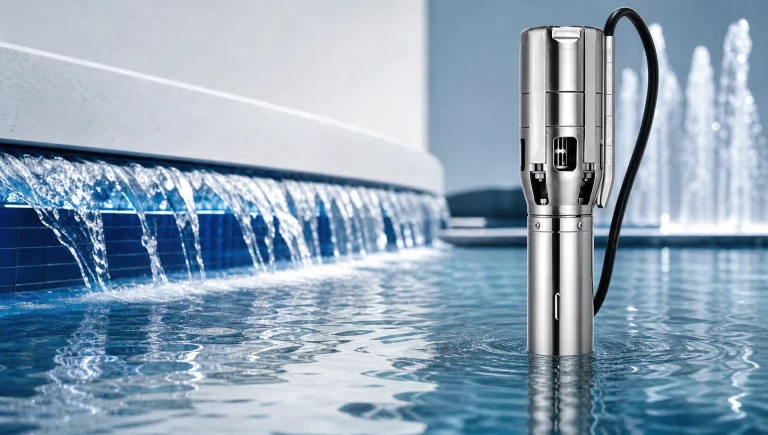
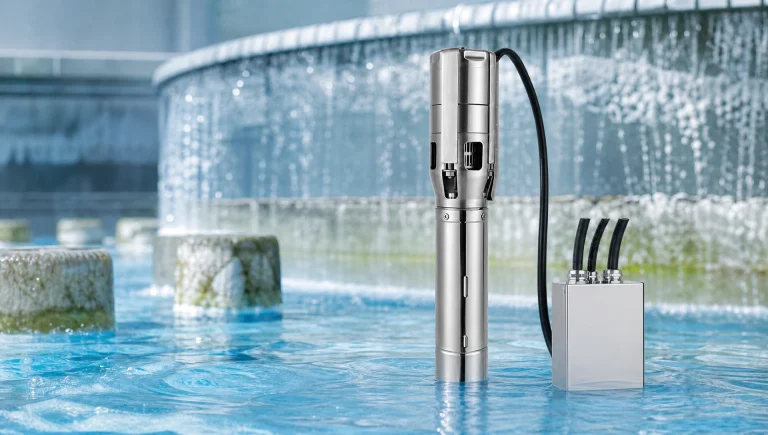
Startup impact and response lag are essentially the structural costs of large motors started directly at line frequency combined with long-pipeline pressure accumulation. The submersible pump approach dissolves both at the control and physical levels: take the submersible pump technology, for example — it comes standard with variable frequency drive, ramping smoothly from zero speed to the target value, dramatically cutting startup current peaks and eliminating impact on the grid and mechanical structure simultaneously. With the pump body located right next to the nozzle, the water column arrives within seconds of the command, delivering true point-and-shoot musical fountain synchronization.
Conclusion & Selection Advice
As the technical analysis and international case studies in this article show, startup impact and response lag does not have to be managed reactively. A fully submerged architecture such as the submersible pump technology removes the root cause at the design stage: Built-in PID closed loop (Automatic frequency and pressure stabilization, smooth and jitter-free water pattern switching), combined with Variable-frequency soft start and Millisecond-level response, makes it a strong candidate for both new fountains and retrofits of existing systems.
Owners and designers are advised to run a pump-type comparison early in the project and contact submersible pump technology technical support for a project-specific selection report.
Keywords: startup impact · response lag · music synchronization · VFD soft start · PMSM
Frequently Asked Questions (FAQ)
How high is the starting current of a traditional high-pressure pump started directly online?
For motors above 30 kW, DOL starting current can reach 5-7 times the rated current. Taking a 55 kW pump (100 A rated current) as an example, DOL inrush current reaches as high as 500-700 A. Even with star-delta reduced-voltage starting, it remains 2.5-3.5 times rated current. This drops circuit breaker contact life from 100,000 operations to 10,000-20,000.
Why do musical fountain water patterns always ‘fall behind’ the musical beat?
The core bottleneck is pipe fill delay. Water travels from pump discharge to nozzle at about 1-3 m/s, and with pipeline lengths of 20-200 m, the delay is 7-200 seconds. For a 100 m pipeline, even if the motor instantly reaches target speed, the water column response is only visible after 67 seconds, while the musical beat interval is just 0.5-2 s. This is a physical limitation that cannot be fully eliminated through software.
How can fountain startup impact and response lag be solved?
Startup impact: install a VFD plus soft starter to limit starting current to below 110% of rated, with an acceleration time of at least 30 seconds; use permanent magnet synchronous motors (PMSM) to eliminate rotor heating. Response lag: place the pump room close to the performance area to keep pipelines within 50 m; adopt a distributed pump set solution to shorten the distance from each pump to its nozzle; use distributed submersible pumps where each nozzle is driven independently — Disney’s ‘World of Color’ uses 400+ small submersible pumps based on this logic.
What are the costs of the ‘main pump always running + valve switching’ approach?
Although this approach solves response lag, the costs are: the pump keeps running at rated power when the fountain is not spraying, increasing energy consumption by 30-50%; valves undergo hundreds of high-pressure differential switching cycles per day, dropping their life from years to months; and rapid valve opening and closing triggers water hammer, forming a vicious cycle. It is a compromise that trades energy consumption and equipment life for show quality.
Can the submersible pump technology really prevent startup impact and response lag?
Yes. The submersible pump technology operates fully submerged, which removes the fundamental trigger of startup impact and response lag at the design level: first, Variable-frequency soft start — Low current peaks, dramatically reduced impact on the grid and pump set; second, Millisecond-level response — Pump located near the nozzle, minimal delay for spray height to follow commands; and third, Built-in PID closed loop — Automatic frequency and pressure stabilization, smooth and jitter-free water pattern switching. Instead of managing symptoms, these three design features make the problem structurally unlikely to occur. For project-specific sizing, contact the pump engineering specialists for a full evaluation.
Recommended Solution: submersible pump technology
The submersible pump technology is engineered for continuous fountain operation and structurally avoids the issue discussed in this article — Fountain Pump Startup Impact & Response Lag: Electrical Surges Shorten Life, Water Patterns Fall Behind the Beat:
- Variable-frequency soft start: Low current peaks, dramatically reduced impact on the grid and pump set
- Millisecond-level response: Pump located near the nozzle, minimal delay for spray height to follow commands
- Built-in PID closed loop: Automatic frequency and pressure stabilization, smooth and jitter-free water pattern switching
Need sizing or engineering support for your project? Contact the the manufacturer through official channels for submersible pump technology technical documentation and project assistance.