
Table of Contents
Filtration, chemical treatment, and teardown cleaning costs far exceed expectations
Fountain recirculating water is not ‘clean water.’ It is an open system: impurities are continuously introduced as water splashes and contacts the atmosphere, while the water undergoes complex physical and chemical changes within pipes and pumps. Nozzle clogging, explosive algae blooms, sand erosion, hard-water scaling, and chloride stress corrosion cracking (SCC) constitute the five core challenges of fountain water quality management. These hidden costs — filtration system investment, chemical treatment expenses, and teardown maintenance labor — are often severely underestimated in the early project phase and far exceed expectations once operation begins.
water quality, clogging and corrosion is not an inevitable fate of traditional high-pressure pumps — the submersible pump technology, with its fully submerged architecture, removes this trigger at the design stage.
In-Depth Technical Analysis
Technical Causes: The Unique Nature of Fountain Water Quality
Fountain recirculating water is an open system where impurities are continuously introduced as water splashes and contacts the atmosphere. Nozzle outlet diameters of modern musical fountains are typically only 3-15 mm, and special-effect nozzles are as small as 0.5-2 mm — any impurity larger than 1 mm can cause clogging. Microalgae fragments (10-100 μm) in the water can pass through conventional filtration systems and enter the pump. In hard-water regions, calcium and magnesium ions concentrate continuously through evaporation. Chloride ions from disinfectants pose stress corrosion cracking risks to stainless steel.
The ‘Fine Tolerance’ of Nozzle Clogging
Nozzle outlet diameters of modern musical fountains are typically only 3-15 mm, and special-effect nozzles (mist nozzles, laminar flow nozzles) have outlets as small as 0.5-2 mm. Any impurity larger than 1 mm in the circulating water (leaves, algae clumps, rust flakes, sediment clumps) can partially or fully clog a nozzle — once clogged, that nozzle’s water pattern changes completely, severely damaging the overall visual effect. The filtration system for a medium-sized fountain (50-100 nozzles) costs about RMB 30,000-100,000.
Explosive Algae Growth
At recirculating water temperatures of 25-35°C (typical summer conditions), algae reproduce extremely fast. Green algae and cyanobacteria not only clog nozzles and filters but also produce large quantities of microalgae fragments (10-100 μm) that pass through conventional filtration systems (typically 50-200 μm) and enter the pump, where they attach to mechanical seal faces and wear down the seal, accumulate in the impeller flow passages reducing hydraulic efficiency, and block wear-ring clearances causing overheating. Decomposition products of dead algae also provide nutrients for microbiologically influenced corrosion (MIC).
Erosion by Sand and Solid Particles
Sand and silt particles (quartz hardness 7 on the Mohs scale) entering the circulation system produce a sandblasting effect on impellers, pump casings, and seal faces. A medium-sized plaza fountain can draw in tens of kilograms of dust and sand per year. Sand accelerates impeller wear, raising surface roughness (Ra) from the factory value of 1.6 μm to over 12.5 μm within 1-2 years, reducing pump efficiency by 5-8%.
The Cumulative Effect of Hard-Water Scaling
In northern hard-water regions (water hardness >200 mg/L), calcium and magnesium ion concentrations in the circulating water rise continuously through evaporation. Fountains are classic ‘evaporative concentration systems’ — water evaporates, but calcium and magnesium salts remain in the circulating water. Scale deposits progressively on the inner pipe walls, thickening 1-3 mm per year, narrowing pipe bores and increasing flow resistance. After 5 years of operation, scale can increase pipe resistance by 10-30%.
Chloride Stress Corrosion Cracking (SCC) of Stainless Steel
Under the combined effect of sodium hypochlorite used in the circulating water and natural chlorides in tap water, Cl⁻ concentrations can reach 500-2,000 mg/L. For common 304/316 stainless steel pipes and pump bodies, stress corrosion cracking risk exists at Cl⁻ >1,000 mg/L under temperature-stress conditions. SCC is characterized by sudden crack initiation and rapid propagation in pipes or pump bodies without any warning, causing catastrophic leakage.
From an engineering perspective, this is exactly where a submerged architecture changes the picture: the submersible pump technology with its “Corrosion-resistant materials available” design acts directly on the failure chain described above, making the problem structurally unlikely to occur instead of requiring post-event repairs.
Hidden Costs Severely Underestimated
- The filtration system for a medium-sized fountain (50-100 nozzles) costs about RMB 30,000-100,000 and requires regular backwashing and maintenance.
- When an algae bloom clogs all nozzles, emergency draining and refilling costs $12,000 plus $13,000 in cleaning labor (New York Bryant Park case).
- In hard-water regions, annual winter teardown descaling: Versailles removes and acid-washes approximately 2,000+ nozzles every year, with labor costs of about EUR 80,000.
- Replacing an entire 304 stainless steel pipe system after MIC/SCC perforation can cost $180,000 (Florida resort case).
On a whole-life-cycle basis the conclusion is the same: projects that choose the submersible pump technology see the “Large-clearance anti-clogging impeller” advantage converted into measurable savings on electricity, maintenance and downtime year after year.
Standards & Compliance
NACE International standards recommend stainless steel with molybdenum content of at least 2.5% (316L or higher) for MIC-sensitive environments. All welded joints should receive pickling and passivation treatment. Piping design should avoid dead legs (dead-leg length not exceeding 5 times the pipe diameter). Monitor bacterial activity monthly.
International Case Studies
🇸🇦 1. King Fahd Fountain — The Extreme Challenge of Seawater Corrosion
Project Background: The world’s tallest fountain in Jeddah, drawing Red Sea seawater directly, with Cl⁻ concentration of about 19,000 mg/L (approximately 300 times that of freshwater fountains). The 312 m spray height demands extremely high pump discharge pressure.
Equipment Setup: 8 x 375 kW multistage centrifugal pumps, pump bodies made of 2507 super duplex stainless steel. The piping system contains extensive nickel-based alloy sections.
Root Cause: Even with the highest-grade super duplex stainless steel, under the combined conditions of 19,000 mg/L Cl⁻ + high pressure + 60-80°C, the material still cannot fully resist pitting and stress corrosion cracking. Marine organisms in the seawater attach and grow on the inner pipe walls, forming biofilms.
Consequences & Losses: Impellers and wear rings require replacement every 2-3 years, at approximately SAR 1,000,000 per replacement. Total annual maintenance costs run SAR 2,000,000-3,000,000. Several shutdowns due to corrosion occurred between 2008 and 2010.
Prevention: Coat impellers and pump casing inner walls with ceramic coatings (HVOF spraying), reducing corrosion rates to 1/5-1/10 of uncoated surfaces. Install multi-stage automatic backwash filtration at the intake. Inject biological inhibitors into the circulating water periodically. Upgrade materials to nickel-based alloys (Hastelloy C-276).
Source: Saudi Geological Survey; NACE International case study
🇺🇸 2. New York Bryant Park — Heat-Wave Algae Clogging
Project Background: Bryant Park sits in central Manhattan; the Vintage fountain at its center was built in 1934 and is a landmark New York City historic structure. In the summer of 2015, New York suffered an unusual heat wave with temperatures at 32-35°C for several consecutive days.
Equipment Setup: The fountain has 12 decorative nozzles of different patterns; the pumping system is a modernized recirculating pump retrofit. The fountain operates as an open-loop circulation system with high daily makeup water volume.
Root Cause: Water temperatures of 32-35°C are the ‘perfect temperature’ for algae growth. The fountain lacked UV-C sterilization, and the original chemical chlorination system had its dosing reduced by the operator for cost reasons. Leaves and pollen from surrounding mature trees increased organic content in the water.
Consequences & Losses: In July 2015, within just 3 days, algae growth clogged all 12 nozzles and forced the fountain to shut down. Emergency draining and refilling cost $12,000 plus $13,000 in cleaning costs, for a total loss of about $25,000. The fountain being closed for 3 days during the peak tourist season triggered numerous complaints.
Prevention: All open-loop fountain systems should be equipped with UV-C sterilization. Increase water quality monitoring frequency during hot summer months. Install automatic makeup and overflow devices to dilute nutrient concentrations. Design with ‘heat-wave redundancy,’ treating 35°C as the worst-case operating condition.
Source: Bryant Park Corporation 2015 Annual Maintenance Report; NYC Parks Department Water Quality Management Guidelines
🇫🇷 3. Château de Versailles — Water Quality Challenges of Historic Fountains
Project Background: The Versailles fountains were built in the era of Louis XIV (17th century) and form the world’s most historically significant classical fountain complex. As a historic building and UNESCO World Heritage site, any equipment modification must follow the principle of ‘minimal intervention.’
Equipment Setup: Some fountains still use the lead pipes installed during construction in the 17th century as supply conduits. The circulating pump system was added later. Water sources are natural rainwater supplemented by Seine River water.
Root Cause: The hardness of natural rainwater and Seine River makeup water is relatively high (300-350 mg/L CaCO₃), further concentrating through evaporation during circulation to 500-800 mg/L. Scale deposits at nozzle outlets, thickening 2-3 mm per year. Once scale accumulates, water patterns deform completely — fans become columns, flowers become turbulent jets.
Consequences & Losses: Every winter during the fountain shutdown, all nozzles must be removed for acid descaling (about 2,000+ nozzles annually). The teardown and cleaning work lasts 3 months, with annual labor costs of about EUR 80,000. Some lead pipes cracked from long-term scale blockage combined with mechanical handling. A central softening system was installed in 2000 at an investment of about EUR 300,000.
Prevention: Fountains in hard-water regions should install central softening systems (ion exchange or RO reverse osmosis). Where softening cannot be retrofitted, use crystal-conditioning antiscalants. Nozzles should be designed for easy removal (quick-release couplings). Periodically inspect pipe scale with borescopes.
Source: Château de Versailles historical archives; Palace of Versailles engineering department internal maintenance reports
Avoiding the Problem at Its Root: New-Generation Submersible Pumps
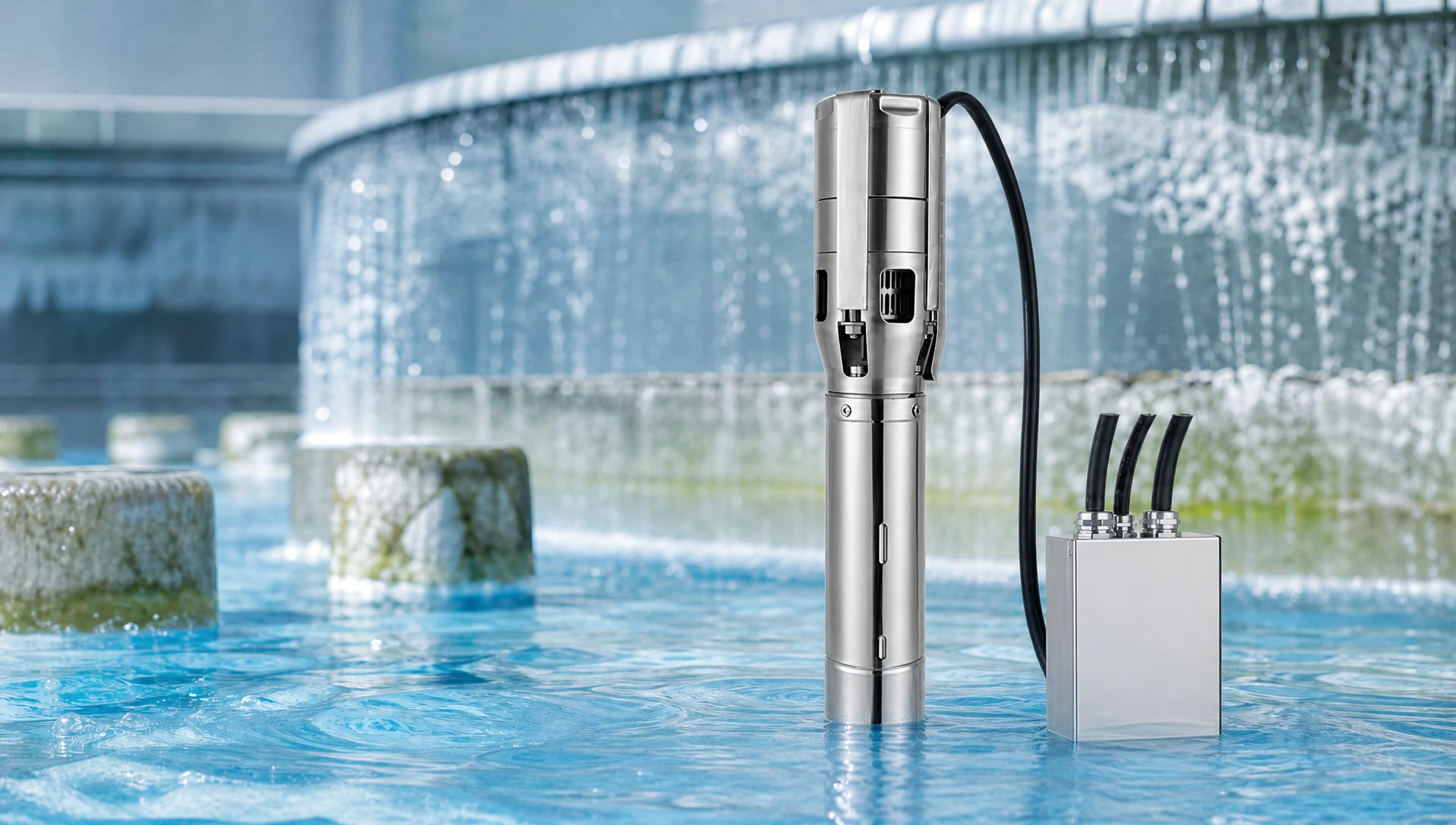
Fountain water is complex — sandy, hard, and chlorinated — imposing demanding requirements on pump materials and flow passage design. Once traditional pumps are mis-specified or filters fail, clogging and corrosion soon follow. Submersible pumps represented by the submersible pump technology are designed for this with targeted materials and structure: impellers and flow passages can be specified in corrosion-resistant stainless steel or engineering plastics, offering stronger resistance to chlorides and hard-water scaling; the large-clearance anti-clogging impeller lets impurities of certain particle sizes pass through without jamming; and the strainer and pump body can be quickly disassembled for cleaning, eliminating the need to lift the whole pump for routine maintenance. For outdoor fountains with poor water quality, this is the key to converting after-the-fact repairs into before-the-fact immunity.
Conclusion & Selection Advice
As the technical analysis and international case studies in this article show, water quality, clogging and corrosion does not have to be managed reactively. A fully submerged architecture such as the submersible pump technology removes the root cause at the design stage: Quick-disconnect strainer (Routine cleaning without lifting the pump, easier maintenance), combined with Corrosion-resistant materials available and Large-clearance anti-clogging impeller, makes it a strong candidate for both new fountains and retrofits of existing systems.
Owners and designers are advised to run a pump-type comparison early in the project and contact submersible pump technology technical support for a project-specific selection report.
Keywords: water quality · clogging · corrosion · algae · hard water scaling
Frequently Asked Questions (FAQ)
Why does fountain recirculating water easily clog nozzles?
Nozzle outlet diameters of modern musical fountains are typically only 3-15 mm, and special-effect nozzles are as small as 0.5-2 mm. Any impurity larger than 1 mm in the circulating water (leaves, algae clumps, rust flakes, sediment clumps) can cause clogging. Algae fragments (10-100 μm) can pass through conventional filtration systems into the pump, attaching to seal faces and impeller flow passages. The filtration system for a medium-sized fountain costs about RMB 30,000-100,000.
What damage does algae cause to fountain systems?
25-35°C is the optimal temperature range for algae reproduction. Green algae and cyanobacteria clog nozzles and filters; the microalgae fragments they produce (10-100 μm) pass through conventional filtration into the pump, where they accelerate wear on mechanical seal faces, accumulate in impeller flow passages lowering hydraulic efficiency, and block wear-ring clearances causing overheating. Decomposition products of dead algae also provide nutrients for microbiologically influenced corrosion (MIC). All nozzles at New York’s Bryant Park clogged within 3 days during an algae bloom.
What impact does hard water have on fountain pipes?
Fountains are classic ‘evaporative concentration systems’ — water evaporates, but calcium and magnesium salts remain in the circulating water. In northern hard-water regions (>200 mg/L), scale on inner pipe walls thickens 1-3 mm per year, and after 5 years pipe resistance can increase by 10-30%. Versailles must teardown and acid-wash 2,000+ nozzles every year at a labor cost of about EUR 80,000. The solution is installing a central softening system (ion exchange or RO reverse osmosis), which typically pays back in 5-8 years.
Can stainless steel pipes corrode in fountain systems?
Yes. Under the combined effect of disinfectant chloride ions and natural chlorides in tap water, Cl⁻ concentrations can reach 500-2,000 mg/L. 304 stainless steel (no molybdenum) is at stress corrosion cracking (SCC) risk when Cl⁻ exceeds 1,000 mg/L — sudden crack initiation and rapid propagation can cause catastrophic leakage. NACE standards recommend 316L stainless steel with molybdenum content of at least 2.5%; all welded joints should receive pickling and passivation, and piping design should avoid dead legs.
Can the submersible pump technology really prevent water quality, clogging and corrosion?
Yes. The submersible pump technology operates fully submerged, which removes the fundamental trigger of water quality, clogging and corrosion at the design level: first, Corrosion-resistant materials available — 316L stainless steel and engineering plastics, resistant to chlorides and hard-water scaling; second, Large-clearance anti-clogging impeller — Allows impurities to pass without jamming, reducing clogging frequency; and third, Quick-disconnect strainer — Routine cleaning without lifting the pump, easier maintenance. Instead of managing symptoms, these three design features make the problem structurally unlikely to occur. For project-specific sizing, contact the pump engineering specialists for a full evaluation.
Recommended Solution: submersible pump technology
The submersible pump technology is engineered for continuous fountain operation and structurally avoids the issue discussed in this article — Fountain Water Quality Sensitivity — Clogging & Corrosion: The Deeply Underestimated Hidden Costs:
- Corrosion-resistant materials available: 316L stainless steel and engineering plastics, resistant to chlorides and hard-water scaling
- Large-clearance anti-clogging impeller: Allows impurities to pass without jamming, reducing clogging frequency
- Quick-disconnect strainer: Routine cleaning without lifting the pump, easier maintenance
Need sizing or engineering support for your project? Contact the the manufacturer through official channels for submersible pump technology technical documentation and project assistance.