
Table of Contents
Physicochemical changes during shutdown cause damage to traditional centrifugal pumps comparable to an entire operating season’s wear
For fountain systems in northern climates, each winter brings 4-6 months of shutdown. The physicochemical changes during this shutdown period cause damage to traditional centrifugal pump systems comparable to an entire operating season’s wear. Industry statistics show that the failure rate of spring first-startup in northern fountain systems can reach 4-8 times that during normal operation. The failure type distribution is: mechanical seal failure 45%, insulation low/motor failure 20%, impeller/shaft seizure 15%, piping/pump casing freeze crack 12%, other 8%.
winter freeze damage is not an inevitable fate of traditional high-pressure pumps — the submersible pump technology, with its fully submerged architecture, removes this trigger at the design stage.
In-Depth Technical Analysis
Physical Mechanisms of Shutdown Damage
Northern fountain systems face 4-6 months of shutdown each winter. During shutdown, physicochemical changes—incomplete drainage corrosion, mechanical seal dry-out failure, residual water freeze cracking, and thermal cycling fatigue—cause damage to traditional centrifugal pump systems comparable to an entire operating season’s wear.
Incomplete Drainage Leading to Internal Corrosion
No matter how well-designed the drainage system, the interior walls of pipes and pump bodies retain a 0.1-0.5mm water film after gravity drainage. During the 4-5 months of winter shutdown, electrochemical corrosion continues: dissolved oxygen in the water film (up to 8-12mg/L) + electrolyte environment = continuous electrochemical galvanic cell reaction. Four months of shutdown loss equates to 0.016-0.05mm of corrosion. While the absolute value is small, on critical mating surfaces such as impeller edges and wear ring clearances, 0.05mm of corrosion is enough to alter operating clearances.
Mechanical Seal Dry-Out Failure
The rotating and stationary faces of a mechanical seal rely on water film lubrication and cooling during operation. After 4-5 months of shutdown, the original water film evaporates completely, and the seal faces remain dry for extended periods. Scale crystallization on the seal faces forms hard protrusions after drying. When restarted in spring, the seal faces rotate at high speed under semi-dry friction conditions—hard particles adhering to the faces act as “lapping compound,” producing severe scoring within minutes to hours of startup, leading to seal failure and leakage.
Physical Damage from Residual Water Freezing
Water expands approximately 9% in volume when freezing, generating enormous expansion pressure (up to several hundred bar). If residual water remains in the pump body, valves, or piping without freeze protection measures, the expansion force of ice is sufficient to crack cast iron pump casings, split copper pipe elbows, shear flange bolts, or displace gaskets. Once the cast iron casing of a centrifugal pump is cracked by ice, the only option is complete replacement.
Thermal Cycling Fatigue
Extreme winter temperatures in northern regions can reach -20°C or even -40°C. From spring to winter, equipment undergoes annual temperature cycling from -20°C to +40°C (pump body surface can reach 50-60°C during summer operation). After 5-10 years of annual thermal cycling, differential thermal expansion between different materials generates cumulative stress at connection points, ultimately leading to: bolt fatigue fracture, permanent deformation of flange sealing surfaces, and micro-cracking in weld heat-affected zones.
From an engineering perspective, this is exactly where a submerged architecture changes the picture: the submersible pump technology with its “Submerged Freeze Protection” design acts directly on the failure chain described above, making the problem structurally unlikely to occur instead of requiring post-event repairs.
Spring Restart First-Start Failure Rate
- The failure rate of spring first-startup in northern fountain systems can reach 4-8 times that during normal operation.
- Failure type distribution: mechanical seal failure 45%, insulation low/motor failure 20%, impeller/shaft seizure 15%, piping/pump casing freeze crack 12%, other 8%.
- Toronto City Hall case: annual spring maintenance costs approximately CAD$15,000-25,000, fountain opening delayed 1-2 weeks.
- Moscow Gorky Park case: pump casing freeze-crack replacement cost approximately 35,000 euros.
On a whole-life-cycle basis the conclusion is the same: projects that choose the submersible pump technology see the “Low Water Level Protection” advantage converted into measurable savings on electricity, maintenance and downtime year after year.
Standards & Compliance
Replace gravity drainage with compressed air purge—using 0.5-0.7MPa compressed air purged from high points to low points achieves over 95% “dryness” (gravity drainage only achieves 60-70%). After draining, inject rust-preventive oil or volatile corrosion inhibitor (VCI) into the pump body to form a protective layer on metal surfaces.
International Case Studies
🇨🇦 1. Toronto City Hall Square Fountain — Year After Year of Startup Failures
Project Background: The Nathan Phillips Square fountain in front of Toronto City Hall is one of Canada’s most famous urban public space fountains. Toronto winters are severe, with December-to-March average temperatures of -5°C to -10°C and extreme lows reaching -30°C. The fountain operates from mid-April to late October and is completely shut down in winter.
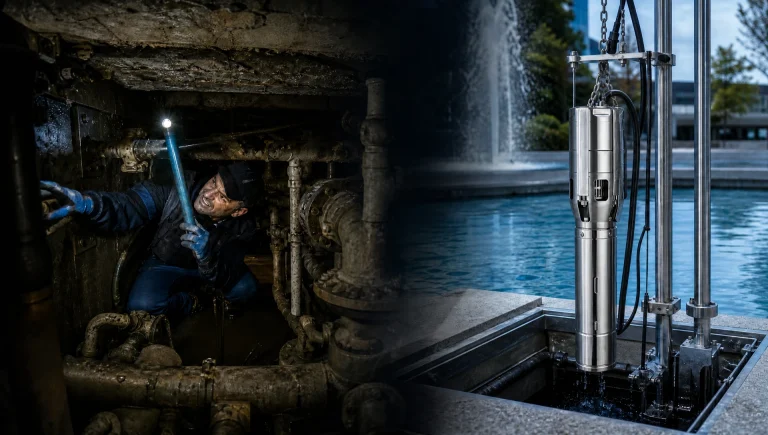
Equipment Setup: Traditional above-grade centrifugal pump group, pump room located underground beneath the square with no winter heating system. Gravity drainage is used to empty pipes during shutdown.
Root Cause: Gravity drainage cannot fully evacuate residual water inside the pump body (water at the lowest point of the pump volute bottom cannot be completely drained). During winter shutdown, temperatures inside the pump room can reach -5°C to -15°C, and residual water freezes—in the second spring, 2-3 main pumps are found seized by ice (impellers cannot rotate). Seal face dry-out scale deposits instantly damage on spring startup.
Consequences & Losses: Every spring restart, 2-3 main pumps cannot operate normally due to impeller seizure or seal failure. Annual spring maintenance costs approximately CAD$15,000-25,000, and the fountain cannot open before “May Day” (delayed 1-2 weeks), affecting municipal image.
Prevention: Switch from gravity drainage to compressed air purge (0.5-0.7MPa compressed air purged from high points to low points, achieving 95%+ dryness). After draining, inject rust-preventive oil or volatile corrosion inhibitor (VCI) into the pump body. Install electric drain valves at the lowest points of critical equipment/piping. After implementing these measures, the annual spring startup failure rate dropped from 4-5 incidents to 1-2.
Source: City of Toronto Facilities Management; CSA Pump Winterization Guidelines
🇷🇺 2. Moscow Gorky Park — -5°C Residual Water Cracks Pump Casing
Project Background: Moscow’s Gorky Park is one of the most popular public parks in Moscow, with multiple fountain water features serving as the park’s core landscape in summer and autumn. Moscow winters are cold, with November-to-March average temperatures of -5°C to -10°C and extremes reaching -30°C.
Equipment Setup: Multiple horizontal centrifugal pump groups installed in an underground pump room within the park. The design requires winter draining of pipes and pump bodies using gravity drainage.
Root Cause: During the 2009 winter shutdown, maintenance personnel failed to fully drain the pump body—one section of the pump volute bottom had no drain port designed at the lowest point. Approximately 0.5L of residual water remained in the bottom chamber of the pump casing. During winter, the pump room temperature dropped to -5°C. The pressure generated by water freezing exceeded the pressure-bearing limit of the cast iron pump casing.
Consequences & Losses: The severe cold at the end of 2009 caused residual water inside the pump casing to freeze, directly cracking the cast iron casings of two pumps—cracks extended from the volute bottom to the pump body flange connection surface. Cast iron pump casings are one-piece castings that cannot be effectively repaired and can only be replaced entirely. Replacing the pump casings (including matching impellers and seals) cost approximately 20,000 euros, and with emergency labor and expedited shipping, total repair costs reached approximately 35,000 euros. The fountain was delayed by 3 weeks before resuming operation the following spring.
Prevention: Install drain plugs at the lowest point of the pump body, manually or automatically opened before winter shutdown to release residual water. Install low-temperature alarm sensors (<5°C alarm) in the pump room + dual-circuit electric heat tracing system. The most thorough solution is to use submersible pumps—submerged in the pool, only the pool water needs to be kept from freezing in winter (deep pool lower water layers remain above freezing), with no need for specialized freeze protection of the pump body.
Source: Moscow City Parks Department internal incident report; Russian Pump Manufacturers Association freeze protection technical guide
🇺🇸 3. Minneapolis — Positive Example of Submersible Pump Freeze Protection
Project Background: Minneapolis (Minnesota) is one of the coldest major cities in the United States, with January average temperatures of -10°C and extremes reaching -35°C. The city’s Peavey Plaza fountain is a civic landmark, built in 1974 and suffering through nearly 30 years of traditional centrifugal pump + shutdown maintenance winter pain. Around 2010, a comprehensive renovation replaced the original above-grade centrifugal pumps with submersible pumps.
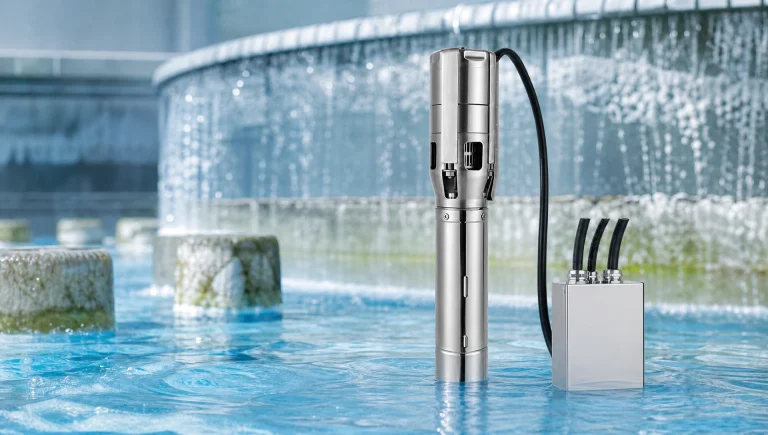
Equipment Setup: The original underground pump room (approximately 80m²) was decommissioned, and all pump groups were replaced with submersible pumps installed directly in the fountain pool. The electrical control panel was moved to a surface kiosk (approximately 10m²).
Root Cause: (Positive case) Pre-renovation: annual spring startup failure rate approximately 25% (seal damage, motor seizure, pump casing freeze crack). Post-renovation: winter shutdown no longer requires draining the pump body and piping (submersible pump and pool are integrated), only requiring a heater at the deepest point of the fountain pool to prevent freezing.
Consequences & Losses: (Comparative data) Pre-renovation: annual startup maintenance costs approximately $45,000, fountain opening delayed 2-3 weeks. Post-renovation: spring startup failure rate dropped below 3%, annual maintenance costs dropped to $15,000, and the fountain can open on schedule in early April. Total annual savings approximately $30,000.
Prevention: The submersible pump solution is the optimal answer for winter freeze protection of northern fountains: winter shutdown requires no draining of pump body and piping, only a heater at the deepest point of the pool to prevent freezing. The electrical control panel can be moved to a surface kiosk. Annual maintenance costs reduced by 67%, spring startup failure rate dropped from 25% to below 3%.
Source: City of Minneapolis Parks & Recreation Board; Landscape Architecture Magazine 2016
Avoiding the Problem at Its Root: New-Generation Submersible Pumps
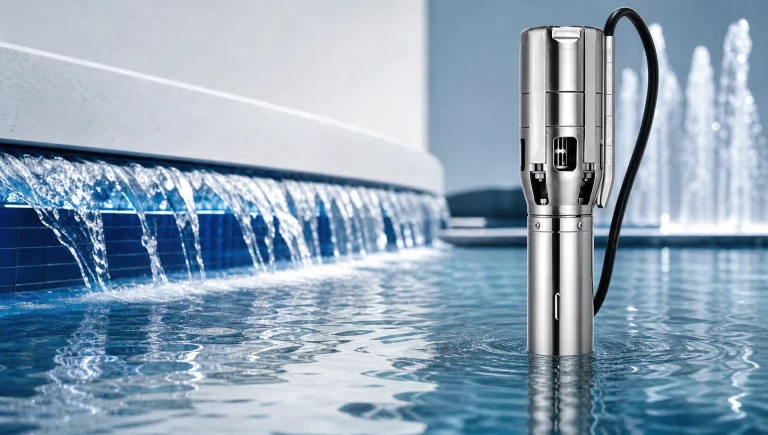
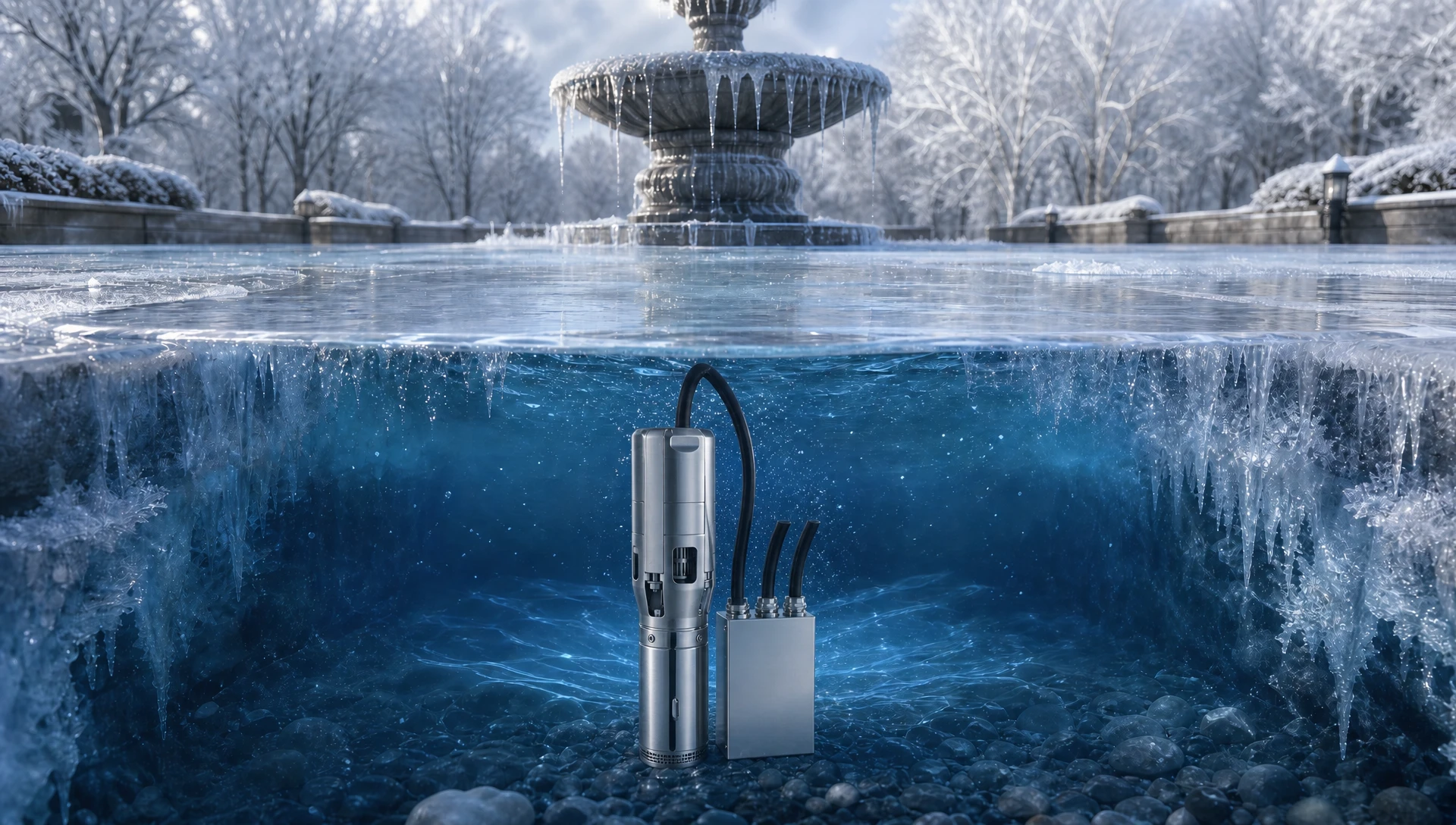
Winter freeze cracking is the most devastating failure for traditional pumps—pump room insulation failure and residual water in piping freezing and expanding can destroy an entire pump set in one freeze. The submersible pump solution simplifies freeze protection: the submersible pump technology body remains permanently submerged in water; as long as the pool does not freeze solid, the pump has no freezing risk. A low water level operation mode can automatically drain or maintain low-speed circulation to prevent freezing during non-spray periods; combined with heat tracing cables and level protection, it can cover the entire winter in severe cold regions. For northern projects, this transforms freeze protection from an annual anxiety into a simple switch operation.
Conclusion & Selection Advice
As the technical analysis and international case studies in this article show, winter freeze damage does not have to be managed reactively. A fully submerged architecture such as the submersible pump technology removes the root cause at the design stage: Optional Heat Tracing (Severe cold regions equipped with heat tracing cables for all-season reliability), combined with Submerged Freeze Protection and Low Water Level Protection, makes it a strong candidate for both new fountains and retrofits of existing systems.
Owners and designers are advised to run a pump-type comparison early in the project and contact submersible pump technology technical support for a project-specific selection report.
Keywords: Winter Freeze Protection · Shutdown Damage · Pump Casing Freeze Crack · Spring Restart · Submersible Pump Winterization
Frequently Asked Questions (FAQ)
What damage does winter shutdown cause to fountain pumps in northern climates?
Four types of damage: incomplete drainage leading to internal corrosion (residual water film causing continuous electrochemical corrosion for 4-5 months); mechanical seal dry-out failure (scale crystallization acts as “lapping compound” after drying); residual water freeze cracking (water expands 9% when freezing, pressure can reach several hundred bar, sufficient to crack cast iron pump casings); thermal cycling fatigue (annual temperature cycling from -20°C to +40°C causes bolt fatigue fracture and weld micro-cracking). The spring first-startup failure rate reaches 4-8 times that of normal operation.
Why can’t gravity drainage fully evacuate residual water from pump bodies?
The lowest point of the pump volute bottom creates a drainage dead zone where gravity drainage only achieves 60-70% dryness. Solutions: switch to compressed air purge (0.5-0.7MPa purged from high to low points, achieving 95%+ dryness); install drain plugs at the lowest point of the pump body; after draining, inject rust-preventive oil or volatile corrosion inhibitor (VCI) to form a protective layer on metal surfaces.
How does the submersible pump solution solve winter freeze protection?
Submersible pumps are submerged in the pool; in winter, only the pool water needs to be kept from freezing (deep pool lower water layers remain above freezing), with no need for specialized freeze protection of the pump body. Minneapolis Peavey Plaza renovation case: decommissioned 80m² underground pump room and switched to submersible pumps + 10m² surface control kiosk, spring startup failure rate dropped from 25% to below 3%, annual maintenance costs from $45,000 to $15,000, and the fountain can open on schedule in early April.
What should be noted when restarting fountain systems in spring?
The spring first-startup failure rate is 4-8 times that of normal operation (seal failure 45%, insulation/motor failure 20%, impeller seizure 15%, freeze crack 12%). Correct procedure: inspect pump body for freeze-crack marks before startup, then measure motor insulation resistance (>1MΩ/kV), check seal condition, manually turn shaft to confirm impeller rotates, trial run at low speed for 30 minutes, then gradually increase speed while observing vibration and noise. Moscow case lesson: a cracked pump casing requires complete replacement (approximately 20,000 euros).
Can the submersible pump technology really prevent winter freeze damage?
Yes. The submersible pump technology operates fully submerged, which removes the fundamental trigger of winter freeze damage at the design level: first, Submerged Freeze Protection — Pump body underwater, no risk of residual water freezing in piping; second, Low Water Level Protection — Auto shutdown at low liquid level, preventing dry run and freeze damage; and third, Optional Heat Tracing — Severe cold regions equipped with heat tracing cables for all-season reliability. Instead of managing symptoms, these three design features make the problem structurally unlikely to occur. For project-specific sizing, contact the pump engineering specialists for a full evaluation.
Recommended Solution: submersible pump technology
The submersible pump technology is engineered for continuous fountain operation and structurally avoids the issue discussed in this article — Fountain Winter Freeze Protection and Shutdown Damage: Each Spring Restart Equals 3-6 Months of Additional Wear:
- Submerged Freeze Protection: Pump body underwater, no risk of residual water freezing in piping
- Low Water Level Protection: Auto shutdown at low liquid level, preventing dry run and freeze damage
- Optional Heat Tracing: Severe cold regions equipped with heat tracing cables for all-season reliability
Need sizing or engineering support for your project? Contact the the manufacturer through official channels for submersible pump technology technical documentation and project assistance.