
Table of Contents
Affinity Laws break down at low frequencies — combined efficiency falls far short of expectations
The VFD is marketed as a ‘fountain energy-saving marvel’ based on the Affinity Laws of centrifugal pumps: power P ∝ n³ (the cube of speed). By this law, when speed drops from 100% to 50%, power should theoretically fall to 12.5% of the original. But reality is far more complex — when the drive lowers the supply frequency below 30 Hz, pump efficiency collapses, motor efficiency decays, and VFD losses increase; the product of the three can bring total system efficiency to as low as 37%. This means the ‘energy-saving myth’ of low-frequency operation shrinks dramatically under real operating conditions.
low-frequency efficiency loss is not an inevitable fate of traditional high-pressure pumps — the submersible pump technology, with its fully submerged architecture, removes this trigger at the design stage.
In-Depth Technical Analysis
Physical Mechanism: Affinity Laws Break Down at Low Frequencies
The Affinity Laws hold only when the pump operates at similar operating points with constant efficiency. At low speeds (low frequencies), efficiency deviates significantly — pump efficiency, motor efficiency, and VFD efficiency all drop simultaneously, making combined efficiency far lower than expected.
Collapse of Pump Efficiency
When the drive lowers the supply frequency below 30 Hz, the pump’s hydraulic efficiency drops sharply. At low speeds, ‘friction losses’ decrease, but ‘mechanical losses’ (bearing friction, seal resistance) remain essentially unchanged, while ‘volumetric losses’ (wear-ring clearance leakage) rise dramatically as a proportion. Field measurements show: pump efficiency around 82% at 50 Hz full frequency, dropping to 68-73% at 40 Hz, 42-50% at 30 Hz, and further to 30-40% at 25 Hz.
Motor Efficiency Decay
Induction motors are designed for optimal efficiency near rated frequency (50/60 Hz). When the drive output frequency drops, the excitation current component in the stator increases, the power factor falls, and losses rise. A typical IE3 motor achieves about 88% efficiency at 40 Hz (94% at rated), 78-82% at 30 Hz, and only 70-75% at 25 Hz.
VFD’s Own Losses
A VFD itself has about 3-5% losses during rectification and inversion. But at low-frequency operation, VFD efficiency also drops to 85-90%. Combined product: total system efficiency = pump efficiency × motor efficiency × VFD efficiency. At 30 Hz, total efficiency may be only 0.50 × 0.82 × 0.90 ≈ 37% — far below the 12.5% power consumption (87.5% savings) predicted by the Affinity Laws.
Motor Cooling Degradation
The cooling fan of an induction motor is mounted coaxially on the motor shaft — cooling airflow is proportional to speed. When driven at 30 Hz, airflow is only 21.6% of rated. This dramatic drop in heat dissipation raises the winding temperature rise by more than 10°C. According to the Arrhenius law, insulation life halves for every 10°C rise. Motors running at low frequency for extended periods face the dual risks of overheating and accelerated insulation aging.
Harmonic Pollution Problems
During front-end rectification, a VFD draws non-sinusoidal current from the grid, generating abundant high-order harmonics (mainly 5th, 7th, 11th, etc.). Harmonic currents create extra Joule heating in transformers and cables, reducing supply efficiency. Harmonics interfere with the fountain’s LED lighting control signals, causing flicker and color shift. Harmonics entering the sound system produce ‘humming’ noise interference, seriously degrading the audio quality of water shows. Active harmonic filters cost RMB 10,000-50,000 per unit.
From an engineering perspective, this is exactly where a submerged architecture changes the picture: the submersible pump technology with its “Immersion cooling” design acts directly on the failure chain described above, making the problem structurally unlikely to occur instead of requiring post-event repairs.
Efficiency Comparison Data
- Pump efficiency is about 82% at 50 Hz full frequency, dropping to 68-73% at 40 Hz, 42-50% at 30 Hz, and 30-40% at 25 Hz.
- An IE3 motor achieves about 88% efficiency at 40 Hz (94% at rated), 78-82% at 30 Hz, and only 70-75% at 25 Hz.
- Total system efficiency = pump efficiency × motor efficiency × VFD efficiency. At 30 Hz it may be only 0.50 × 0.82 × 0.90 ≈ 37%.
- PMSM maintains efficiency above 90% across 50-100% of rated speed, completely free of the low-frequency efficiency trap.
On a whole-life-cycle basis the conclusion is the same: projects that choose the submersible pump technology see the “Full-frequency-range matching” advantage converted into measurable savings on electricity, maintenance and downtime year after year.
Standards & Compliance
The California Energy Commission report CEC-500-2016-031, ‘VFD Retrofit Evaluation in Commercial Fountain Applications,’ systematically assessed the actual energy savings of VFD retrofits. During the design phase, suppliers should be required to provide ‘total system efficiency versus frequency curves’ at actual operating points (including combined pump + motor + VFD efficiency), rather than only theoretical curves based on the Affinity Laws.
International Case Studies
🇺🇸 1. California Commercial Plaza — VFD Retrofit Savings Far Below Expectations
Project Background: An indoor atrium fountain at a large commercial plaza in California, built in 2008 and retrofitted for energy efficiency in 2012. Located in Silicon Valley, the local Title 24 building energy standard requires energy assessments for large public fountains.
Equipment Setup: Six 75 kW horizontal centrifugal pumps, all originally started at fixed frequency DOL. $180,000 was invested in 2012 to add VFD control. The fountain’s typical operating mode is low-spray (spray height at 30-40% of maximum), running about 12 hours per day.
Root Cause: In low-spray mode the pumps actually operate in the 25-30 Hz range, right in the ‘low-frequency efficiency trap’ zone. Measured combined efficiency was only 52-62%. The original savings prediction used idealized Affinity Laws (P ∝ n³) without accounting for actual efficiency decay at low frequencies. The pumps were not selected or optimized for variable-frequency operation.
Consequences & Losses: Actual savings were only 15% (annual electricity cost fell from $156,000 to $132,600), far below the originally advertised 35%. The payback period extended from the planned 2.5 years to 6.8 years, and the return on investment badly missed targets.
Prevention: Require suppliers to provide total system efficiency-frequency curves at actual operating points. Prioritize permanent magnet synchronous motors (PMSM) for low-frequency operating ranges. If low-frequency operation is unavoidable, use externally powered fans or water-cooled motors. Install harmonic filters and output reactors.
Source: California Energy Commission Report CEC-500-2016-031
🇯🇵 2. Osaka Castle Park — A Positive Case of PMSM Replacement
Project Background: The musical fountain in Osaka Castle Park, built in the 1990s, is one of the most famous public fountains in the Kansai region. In 2015, the Osaka City Parks Bureau decided on a comprehensive upgrade of the aging fountain system.
Equipment Setup: Before the retrofit: 4 x 60 kW traditional pumps + VFD. After: 6 x 22 kW PMSM submersible pumps.
Root Cause: The original system operated in the 25-32 Hz range in low-spray mode: total system efficiency was only 45-55%, with annual electricity costs of around JPY 18 million. Average annual maintenance costs were about JPY 3 million.
Consequences & Losses: (Comparison data) Before the retrofit, worst-case operating point (8 m spray height): system power draw 28.5 kW. After the retrofit, the PMSM submersible pump at the same operating point draws 19.2 kW. Energy savings of 32.6%.
Prevention: PMSM maintains efficiency above 90% across 50-100% of rated speed, completely free of the low-frequency efficiency trap. The submersible pump approach also completely eliminated cavitation, seal leakage, and pump room noise. Total retrofit investment was approximately JPY 48 million, with a payback period of about 6.8 years.
Source: EBARA Technical Report; Osaka City Parks Bureau renovation works report
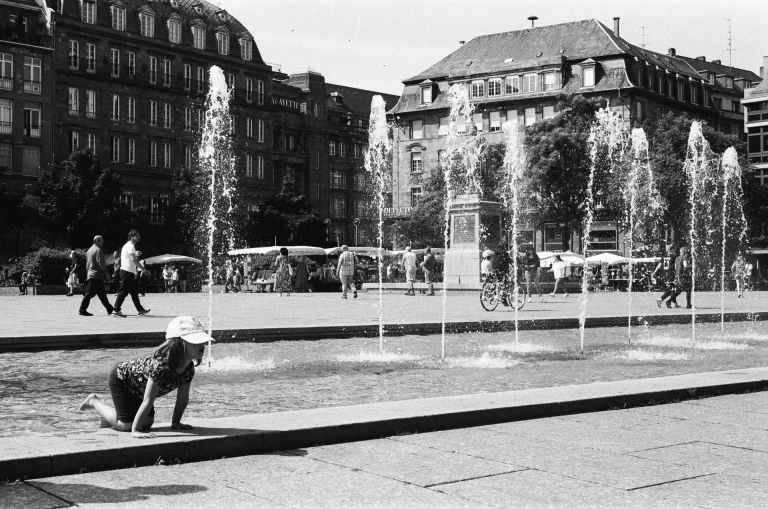
🇩🇪 3. Potsdamer Platz Berlin — VFD + Inverter-Duty Motor Combination
Project Background: Potsdamer Platz is one of Europe’s largest urban redevelopment projects; its musical fountain was designed by a well-known Italian water feature company. The surrounding commercial and residential areas impose strict requirements on noise and energy efficiency.
Equipment Setup: 8 x 40 kW centrifugal pumps, each with its own dedicated VFD. ‘Inverter-duty motors’ were selected — equipped with independent forced cooling fans and Class H insulation (temperature rating 180°C).
Root Cause: (Positive case) The design phase thoroughly evaluated the efficiency decay of VFDs at low speeds. Operations were planned around ‘high-efficiency windows’: water patterns were achieved through group switching, with each pump group avoiding operation below 30 Hz. Piping was designed as a ring circuit to lower the resistance curve.
Consequences & Losses: (Positive case, no losses) Total system efficiency stayed above 65% across all operating conditions (about 66% at the lowest point of 30 Hz), with annual energy consumption about 20% lower than an unoptimized design. The motors have operated for 6+ years with no insulation failures.
Prevention: Select inverter-duty motors to solve the cooling problem. Plan operations around ‘high-efficiency windows’ to avoid operation below 30 Hz. Design piping as a ring circuit to reduce resistance. Install harmonic filters and conduct comprehensive power quality testing. This demonstrates that sound engineering design can largely mitigate the VFD low-frequency efficiency trap.
Source: Berlin Potsdamer Platz water feature project completion documents
Avoiding the Problem at Its Root: New-Generation Submersible Pumps
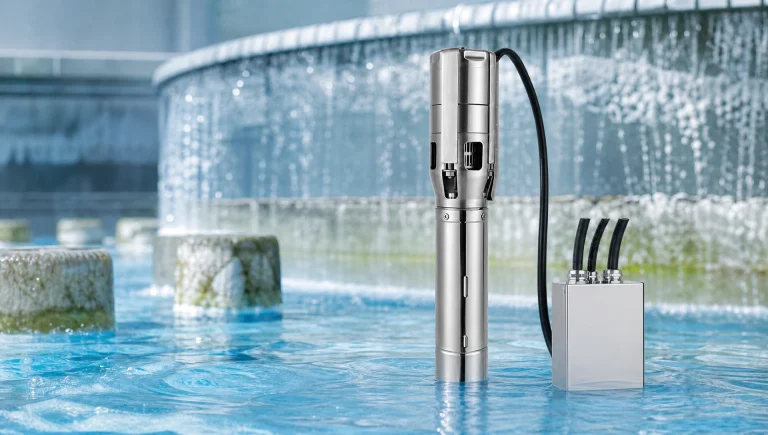
The essence of the low-frequency efficiency trap is that traditional induction motors and split pumps suffer a sharp rise in copper and iron losses plus cooling degradation at low frequencies, causing efficiency to fall off a cliff. Submersible pumps’ immersion cooling happens to crack this deadlock: take the submersible pump technology, for example — the motor dissipates heat naturally in the water, keeping winding temperature stable even during prolonged low-frequency operation, with a noticeably flatter efficiency curve at low frequencies. Combined with the integrated impeller-motor matching design, full-frequency-range combined efficiency outperforms generic motor plus generic pump combinations. For musical fountains with frequently changing spray heights, this solution delivers real savings on electricity bills.
Conclusion & Selection Advice
As the technical analysis and international case studies in this article show, low-frequency efficiency loss does not have to be managed reactively. A fully submerged architecture such as the submersible pump technology removes the root cause at the design stage: Wide speed range (Stable wide-range speed control, adapting to the ever-changing water patterns of musical fountains), combined with Immersion cooling and Full-frequency-range matching, makes it a strong candidate for both new fountains and retrofits of existing systems.
Owners and designers are advised to run a pump-type comparison early in the project and contact submersible pump technology technical support for a project-specific selection report.
Keywords: variable frequency drive · VFD · low-frequency efficiency · PMSM · Affinity Laws
Frequently Asked Questions (FAQ)
Why does VFD energy savings collapse below 30 Hz?
The Affinity Law P ∝ n³ assumes constant efficiency, but at low frequencies all three efficiencies drop simultaneously: pump efficiency falls from 82% (50 Hz) to 42-50% (30 Hz); motor efficiency falls from 94% to 78-82%; and VFD efficiency drops to 85-90%. Total system efficiency = pump × motor × VFD, which at 30 Hz may be only 37% — far from the theoretical 12.5% power draw.
What damage does low-frequency VFD operation cause to motors?
The cooling fan is coaxial with the shaft; at 30 Hz, airflow is only 21.6% of rated, raising the winding temperature rise above 10°C. Per the Arrhenius law, insulation life halves for every 10°C rise. Additionally, VFD PWM pulses have extremely high voltage change rates (5,000-10,000 V/μs); the first few winding turns bear 60-80% of the pulse voltage amplitude, producing frequent partial discharge in humid environments that erodes insulation until short circuit.
How can the VFD low-frequency efficiency trap be solved?
The optimal solution is permanent magnet synchronous motors (PMSM), which maintain efficiency above 90% across 50-100% of rated speed, completely free of the low-frequency efficiency trap. Other solutions: select inverter-duty motors (independent forced cooling fan + Class H insulation); plan operations around ‘high-efficiency windows’ to avoid operation below 30 Hz; design piping as a ring circuit to reduce resistance; and install harmonic filters. The Osaka Castle Park retrofit to PMSM submersible pumps saved 32.6% energy.
How large is the gap between actual and theoretical energy savings from VFD retrofits?
The California commercial plaza case shows that after investing $180,000 in VFDs, actual savings were only 15%, far below the advertised 35%. The payback period extended from 2.5 years to 6.8 years. The reason: in low-spray mode the pumps operated in the 25-30 Hz low-frequency efficiency trap zone, with combined efficiency of only 52-62%, rather than the 87.5% savings predicted by the Affinity Laws.
Can the submersible pump technology really prevent low-frequency efficiency loss?
Yes. The submersible pump technology operates fully submerged, which removes the fundamental trigger of low-frequency efficiency loss at the design level: first, Immersion cooling — Windings stay cool during prolonged low-frequency operation, breaking through the derating limits of traditional motors; second, Full-frequency-range matching — Integrated impeller-motor design, gentler efficiency decay at low frequencies; and third, Wide speed range — Stable wide-range speed control, adapting to the ever-changing water patterns of musical fountains. Instead of managing symptoms, these three design features make the problem structurally unlikely to occur. For project-specific sizing, contact the pump engineering specialists for a full evaluation.
Recommended Solution: submersible pump technology
The submersible pump technology is engineered for continuous fountain operation and structurally avoids the issue discussed in this article — VFD Low-Frequency Efficiency Trap: Energy Savings Collapse Below 30 Hz:
- Immersion cooling: Windings stay cool during prolonged low-frequency operation, breaking through the derating limits of traditional motors
- Full-frequency-range matching: Integrated impeller-motor design, gentler efficiency decay at low frequencies
- Wide speed range: Stable wide-range speed control, adapting to the ever-changing water patterns of musical fountains
Need sizing or engineering support for your project? Contact the the manufacturer through official channels for submersible pump technology technical documentation and project assistance.